Advanced Blood Pressure Assessment Beyond the Cuff
A clinically validated approach to cardiovascular assessment using central blood pressure and arterial waveform analysis to inform risk, guide care, and monitor change over time.


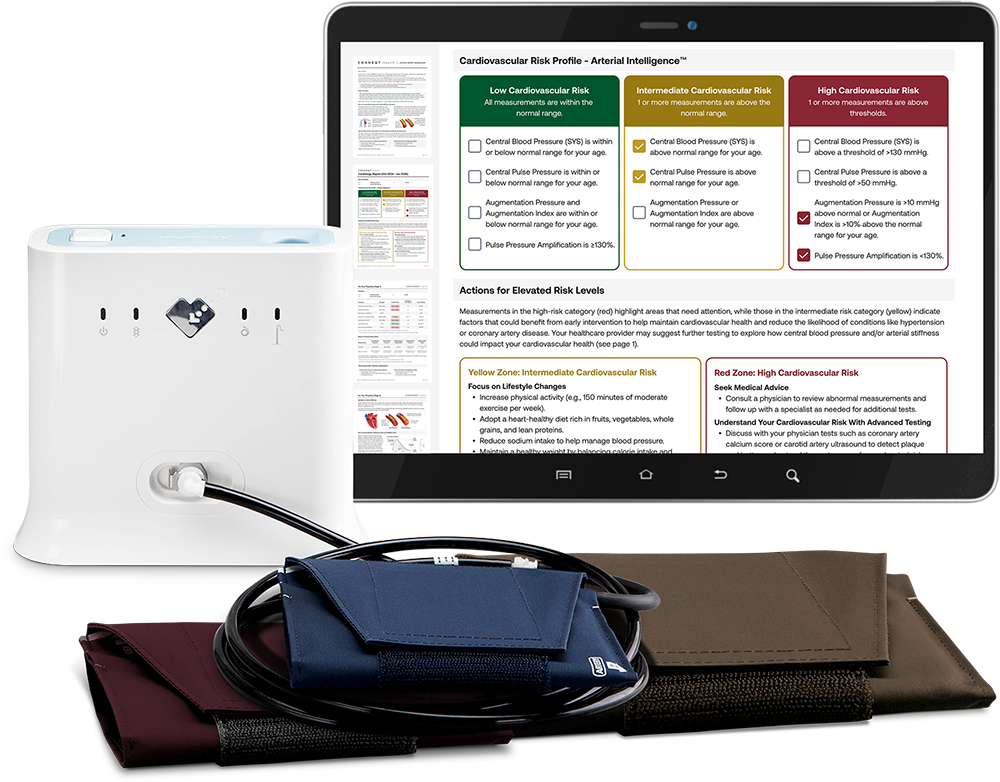
Why Brachial Blood Pressure Alone Is Insufficient
Brachial blood pressure alone may underestimate cardiovascular load. SphygmoCor XCEL assesses peripheral and central pressure and arterial stiffness for a more complete hemodynamic profile.
Peripheral pressure misrepresents central load
Central aortic pressure better reflects myocardial and cerebrovascular stress.
Residual risks despite controlled brachial BP
Patients can appear “controlled” while central pressure remains elevated.
Vascular aging precedes overt hypertension
Waveform-derived metrics surface risk earlier in the disease trajectory.
From Routine Measurement to Actionable Vascular Insight
Assess central blood pressure, arterial stiffness, and cardiac workload from a single, non-invasive measurement, with tools to review results and support clinical decision-making.

Central Blood Pressure
Assess pressure at the level of the aorta, not just the arm. Central blood pressure more directly reflects cardiac load and vascular risk than brachial measurements alone.

Arterial Stiffness
Quantify arterial stiffness, a key marker of vascular aging and cardiovascular risk. Elevated stiffness increases cardiac workload and is used clinically in risk stratification and research.

Cardiac Load and Wave Reflection
Evaluate the relationship between arterial wave reflection and cardiac workload. When forward flow and reflected waves are mismatched, myocardial load increases.

Longitudinal Assessment
Monitor vascular measures over time to evaluate the impact of therapy, lifestyle change, or disease progression using repeat, standardized assessments.

Clinical Reporting
Generate clinician-ready reports integrating central pressure, arterial indices, and brachial blood pressure to support interpretation and care planning.

Designed for Longitudinal Use
A usage-based model that enables clinical deployment without capital purchase, aligning cost with actual assessment volume.
Vascular Aging Captures Cumulative Arterial Change
Unlike brachial blood pressure, which reflects pressure at a moment in time, vascular aging reflects the cumulative effects of arterial stiffening that shape long-term cardiovascular risks.

Point-in-Time Blood Pressure
Blood pressure answers “where are you today?”

Vascular Aging Measures
Vascular aging helps answer “how fast are things changing?”
The Clinical Value of Measuring Vascular Aging
Assessing cumulative arterial change adds a physiologic layer that complements blood pressure by reflecting arterial structure and function over time, informing longitudinal assessment of vascular risk and progression.
Fits Into Existing Clinical Practice
Arterial Health Assessment can be performed alongside routine blood pressure measurement, with results available immediately and supported by existing reimbursement pathways.
1
Routine Cuff Placement
Applied like a standard upper-arm blood pressure cuff.
2
Single Measurement Capture
A single measurement captures brachial pressure and arterial waveform data in approximately two minutes.
3
Immediate Clinical Output
Results are available immediately in a clinician-ready format for review, documentation, and follow-up discussion.
CONNEQT Arterial Health Assessment vs. Standard BP Monitors
Standard blood pressure monitors report peripheral pressure at the arm. CONNEQT Arterial Health Assessment extends assessment to central blood pressure and arterial hemodynamics, enabling a more complete evaluation of cardiovascular load and vascular health.
Used in Clinical Practice and Research Worldwide
Adopted by clinicians, health systems, and researchers to support advanced cardiovascular assessment and longitudinal vascular monitoring.
Clinical-Grade Assessment, Without Capital Investment
In-clinic blood pressure and arterial assessments delivered through a usage-based model that aligns cost with clinical demand.
Base subscription
Month-to-Month
Flexible
$375
25 assessments included
Annual Plan
Save 20%
$300
25 assessments included
Additional assessments
(month-to-month)
(annual plan)
Add-on packs (annual plans only)
+50 assessments/month: $500/month ($10 per additional assessment)
+100 assessments/month: $800/month ($8 per additional assessment)
One-time setup fee
$2,500 per site for device preparation, staff training, and onboarding
Reduced setup fee available with multi-year commitment