Hypertension
Personalize Management Strategies for Blood Pressure Control
with Digital Vascular Biomarkers
1 in 3
Worldwide, 1 in 3 adults has high blood pressure.1
131b
High blood pressure costs the United States about $131 billion each year.2
23%
About 1 in 4 adults with hypertension has their hypertension under control.3
Hypertension and Arterial Stiffening Go Hand-in-Hand


Aortic stiffness is a determinant of isolated systolic hypertension.
Safar ME et al.
Circulation 2003
Artery stiffness is an independent predictor of cardiovascular events in patients with hypertension.

Measuring and monitoring arterial stiffness may improve cardiovascular risk determination.
Sehestedt T et al.
Eur Heart J 2010

Hypertension and Arterial Stiffness
Precision Hypertension Management

Measuring arterial stiffness with vascular biomarkers is key for managing hypertension risks and improving outcomes. These biomarkers offer insights into arterial health, enabling early detection and timely interventions. Additionally, they help customize treatment plans, allowing for proactive adjustments in medication and lifestyle, thus reducing hypertension's burden and enhancing patient quality of life.

Utility of Vascular Biomarkers in Hypertension Management

Irrespective of the brachial blood pressure status, central hypertension increased cardiovascular and cerebrovascular risk indicating the importance of controlling central hypertension.
Cheng YB, Thijs L, Aparicio LS, Huang QF, et al.
Hypertension
One standard deviation decrease in arterial elasticity was associated with 15% greater risk of hypertension, independent of established risk factors for hypertension and the level of baseline blood pressure.
Liao D, Arnett DK, Tyroler HA, Riley WA, et al.
Hypertension
Central pulse pressure over 24 hours is helpful to identify young hypertensive patients with low cardiovascular risk who are in fact at risk of facing a cardiovascular event.
Cremer A, Boulestreau R, Gaillard P, Lainé M, et al.
Journa of American Heart Association
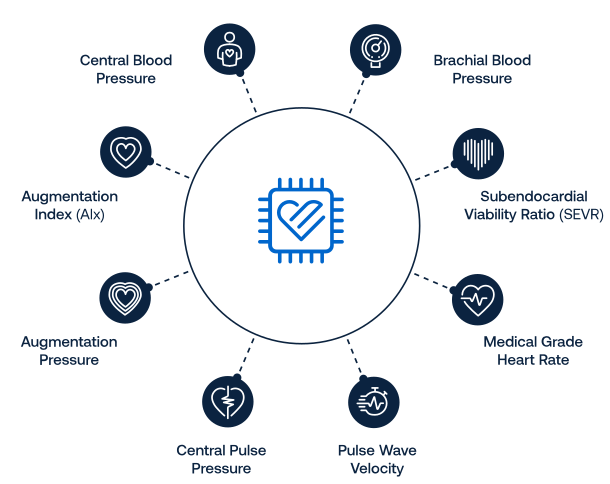
Vascular Biomarkers Explained
Vascular biomarkers are revolutionizing not only cardiovascular health management but also clinical research and personal wellness strategies.
These critical indicators offer a comprehensive evaluation of the cardiovascular system's health across a broad spectrum, from clinical trials to individual health monitoring. By assessing key markers such as endothelial function, arterial stiffness, and coronary flow reserve, they enable a nuanced understanding of cardiovascular risks and conditions.
This valuable insight facilitates early intervention, personalized health optimization, and the development of targeted treatments in clinical settings, significantly advancing patient care and wellness initiatives.
What it Is
Brachial blood pressure measures the pressure of blood at the brachial artery using a blood pressure cuff.
Why it Matters
High blood pressure is a major risk factor for heart disease and stroke, both of which are leading causes of death in the US.
What it Is
Calculated using pulse wave analysis and a traditional brachial cuff, central blood pressure measures pressure at the root of the aorta.
Why it Matters
Central blood pressure reflects key vascular issues such as arterial stiffness, which makes it a more accurate predictor of subclinical cardiovascular disease than traditional brachial blood pressure alone.
What it Is
Subendocardial viability ratio measures the supply of blood that flows to your inner heart muscle in relation to demand.
Why it Matters
SEVR offers insight into how well a person’s heart can handle the stress of exercise.
What it Is
Augmentation pressure refers to the increase in central aortic pressure caused pressure wave reflection.
Why it Matters
A marker of arterial stiffness, elevated augmentation pressure is associated with cardiovascular risk factors as well as increased cardiovascular morbidity and mortality.
What it Is
An indirect measure of arterial stiffness that increases with age, augmentation index reflects the burden stiff arteries place on the heart.
Why it Matters
Chronic stress on the heart and the cardiovascular system can lead to heart failure and hypertrophy (enlarged heart).
What it Is
The height of pressure at the heart, central pulse pressure shows the pressure to which key organs like the heart, brain, and kidneys are exposed.
Why it Matters
Central pulse pressure helps identify the risk of end organ damage to key organs like the brain, kidney and heart.
What it Is
Pulse wave velocity measures arterial stiffness.
Why it Matters
Increases in arterial stiffness are generally based on the loss of elasticity in the aorta artery walls over time and increases the strain on the heart from heightened pressures. Increased aortic stiffness using PWV is a validated predictor of cardiovascular events and all-cause mortality.
Central Blood Pressure
What it Is
Calculated using pulse wave analysis and a traditional brachial cuff, central blood pressure measures pressure at the root of the aorta.
Why it Matters
Central blood pressure reflects key vascular issues such as arterial stiffness, which makes it a more accurate predictor of subclinical cardiovascular disease than traditional brachial blood pressure alone.
Brachial Blood Pressure
What it Is
Brachial blood pressure measures the pressure of blood at the brachial artery using a blood pressure cuff.
Why it Matters
High blood pressure is a major risk factor for heart disease and stroke, both of which are leading causes of death in the US.
Subendocardial Viability Ratio
What it Is
Subendocardial viability ratio measures the supply of blood that flows to your inner heart muscle in relation to demand.
Why it Matters SEVR offers insight into how well a person’s heart can handle the stress of exercise.
Medical Grade Heart Measurement
What it Is
A beat-to-beat heart rate measurement on par with standard ECG-based methods.
Why it Matters
A consistently high resting heart rate may be a sign of coronary heart disease and is associated with a greater risk of stroke.
Central Pulse Pressure
What it Is
The height of pressure at the heart, central pulse pressure shows the pressure to which key organs like the heart, brain, and kidneys are exposed.
Why it Matters
Central pulse pressure helps identify the risk of end organ damage to key organs like the brain, kidney and heart.
Pulse Wave Velocity
What it Is
Pulse wave velocity measures arterial stiffness.
Why it Matters
Increases in arterial stiffness are generally based on the loss of elasticity in the aorta artery walls over time and increases the strain on the heart from heightened pressures. Increased aortic stiffness using PWV is a validated predictor of cardiovascular events and all-cause mortality.
Augmentation Pressure
What it Is
Augmentation pressure refers to the increase in central aortic pressure caused pressure wave reflection.
Why it Matters
A marker of arterial stiffness, elevated augmentation pressure is associated with cardiovascular risk factors as well as increased cardiovascular morbidity and mortality.
Augmentation Index
What it Is
An indirect measure of arterial stiffness that increases with age, augmentation index reflects the burden stiff arteries place on the heart.
Why it Matters
Chronic stress on the heart and the cardiovascular system can lead to heart failure and hypertrophy (enlarged heart).
Incorporate Vascular Biomarkers into Hypertension Management

In-Clinic
- Provide a comprehensive assessment of the patient's cardiovascular health and risk stratification.
- Establish regular follow-up and re-assessment of vascular biomarkers to adjust treatment as the patient’s vascular status changes.
- Reimbursable with CPT 93050.

At Home
- Regular measurements of vascular biomarkers can provide ongoing insights into cardiovascular health.
- Integration with telemedicine enables an ongoing patient-provider interaction and enhances personalized care.
- Reimbursable with CPT 9945x & 99091.
Related Case Studies

1 World Health Organization
2,3 CDC Facts About Hypertension