

Arterial health improves on a timeline that’s shorter than most people assume and more variable than any single number suggests. Here’s what the evidence shows about how long it takes and what drives it.
Most people who search “how long does it take to improve arterial health” aren’t looking for a lecture on complexity. They’re looking for a real answer.
The research has one.

Medical Grade, Accurate, FDA-Cleared Heart Insights.
Save 10% on checkout with code VITALITY
Studies across a broad range of adults suggest that meaningful arterial improvement is measurable on a timeline that’s shorter than most people expect. The marker researchers track most consistently is pulse wave velocity, a measure of arterial stiffness. Across studies averaging roughly 11 weeks of consistent aerobic exercise, that marker moved in the right direction.
That’s approximately three months. Not years.
The exact timeline varies. Age, baseline arterial health, and the type of exercise all shape what’s possible and how quickly. Someone starting with elevated arterial stiffness may see measurable change sooner than someone already in a healthy range.
For people managing high blood pressure, the research points to a somewhat longer window before significant improvement appears.
But the direction is consistent across the evidence. And the timeframe is more encouraging than most people expect.
This guide explains what the research shows about how long improvement takes, which habits move the needle most, and why tracking over time matters more than any single intervention period.
What exercise does, and how quickly
Of all the factors that influence arterial health, exercise has the strongest evidence behind it. Within exercise, aerobic training leads the way.
Aerobic exercise
A 2023 meta-analysis published in Open Heart looked at 79 studies covering more than 3,700 adults. Both healthy individuals and people managing long-term conditions were included.
The finding: aerobic exercise produced meaningful reductions in arterial stiffness. The studies in that analysis ran for an average of 11 weeks, roughly three months of consistent training.
That result held across both groups. The direction of benefit was consistent.
A note on interpreting that figure: the variation across the 79 studies was considerable. Different people, different exercise programs, different starting points. The 11-week average is a useful reference point. It is not a fixed personal timeline.
Age also plays a role. The same analysis found that older adults tended to see somewhat smaller changes, even when the direction of benefit stayed consistent.
For people managing high blood pressure, the timeline is longer. A 2025 meta-analysis focused specifically on adults with hypertension or elevated blood pressure found that less than 12 weeks of aerobic exercise did not produce significant improvement. Twelve weeks or more was where meaningful change appeared.
A separate analysis in women with hypertension found significant improvement after 12 to 20 weeks of aerobic training.
The pattern is consistent: aerobic exercise works. Where you start and how long you sustain it shapes how quickly that shows up.
Resistance training
The picture with resistance training is more variable, and the intensity of training makes a meaningful difference.
Unlike aerobic exercise, resistance training does not consistently reduce arterial stiffness across studies. High-intensity resistance training can temporarily increase arterial stiffness. That effect doesn’t last, but it points to why intensity matters when arterial health is the goal.
Low-to-moderate intensity resistance training is more promising. A small 9-week randomized controlled trial found meaningful improvements in central blood pressure, the pressure closer to the heart, and in how well blood vessels respond to increased flow. Both are useful markers of vascular health. The sample was small, so this is supporting evidence rather than a definitive finding.
The practical takeaway: resistance training is not counterproductive. But if improving arterial stiffness is the primary goal, aerobic exercise is the more reliable tool. If you already resistance train, pairing it with consistent aerobic work gives you the strongest combined signal.
Why exercise improves your arteries
The 11-week finding above answers the “how long” question. But it raises a natural follow-up: what is exercise actually doing to your arteries that produces that change?
The answer starts with blood flow.
When you exercise, your heart pumps faster and blood moves through your arteries at higher speed. That faster flow creates a physical force on the inner lining of your arterial walls called shear stress. Your arteries are built to sense that force and respond to it.
The response is specific. The cells lining the arterial wall detect the increased flow and release nitric oxide, a molecule that relaxes the vessel and makes it more elastic. That single mechanism, repeated consistently over weeks, triggers a chain of adaptations: the arterial wall becomes more responsive, oxidative stress decreases, and the vessel itself can physically remodel to accommodate blood flow more efficiently.
This is why a single workout doesn’t change your arteries. One session produces a temporary response. But when that signal is repeated consistently, the arteries adapt structurally. They become more flexible, more responsive, and less stiff.
It is also why the research clusters around 11 to 12 weeks. That is roughly how long it takes for consistent repetition to produce measurable structural change in the arterial wall.
The deeper point is this: consistency is not just a training principle. It is a biological one. Your arteries respond to what you repeat.
What else influences the timeline
Exercise is the most powerful lever. But it doesn’t operate in isolation. Several other factors can either support or slow the process. None of them come with the same defined timelines as the exercise research. But they’re all worth understanding.
Diet
A 2025 systematic review of 16 studies found a consistent relationship between Mediterranean diet adherence and lower augmentation index, a measure of how much extra pressure the heart has to work against with each beat.
The evidence for pulse wave velocity was present but less uniform across studies. And no clear dietary timeline exists in the published literature.
Diet works best alongside exercise, not as a substitute for it.
What you eat shapes the environment your arteries operate in. Consistent aerobic training combined with a diet that supports vascular health gives you a stronger combined signal than either alone.
Sleep
A 2023 meta-analysis of 11 studies covering more than 100,000 adults found that both too little and too much sleep were associated with higher arterial stiffness compared to the recommended range.
The too-much-sleep finding is worth a brief note. In research, long sleep is often linked to underlying health conditions rather than being a direct cause of arterial stiffness. It’s less a warning about oversleeping and more a signal that overall health context matters.
Short sleep, defined as under seven hours, showed the strongest association with increased arterial stiffness, particularly in adults managing conditions like diabetes, high blood pressure, or obesity.
This type of research tracks patterns across large groups but can’t prove that changing one factor directly causes the other to change. Even so, the signal is consistent across a large body of evidence.
Sleep is something most people can work on. Unlike many cardiovascular risk factors, it doesn’t require equipment, a gym, or a major schedule overhaul. In that sense it sits alongside exercise as one of the more accessible levers available.
Stress
Chronic psychological stress is associated with increased arterial stiffness and changes in endothelial function. That’s the term researchers use for how well the inner lining of your arteries responds to changes in blood flow.
A 2024 review published in Nature Reviews Cardiology outlines the pathway clearly. Sustained stress activates the body’s stress response systems, which over time affect how blood vessels function and how stiff arteries become.
This type of research explains the biological pathway rather than measuring whether a specific intervention changes the outcome. There is no study showing that stress reduction produces a measurable change in arterial stiffness within a defined number of weeks.
But the connection is real. Chronic stress isn’t just a wellbeing issue. It has a direct biological link to arterial health.
Smoking
The evidence here is among the clearest of any lifestyle factor.
A large population-based study published in 2023 found that chronic smoking was strongly and dose-dependently associated with increased arterial stiffness, regardless of sex. The more someone smoked, the greater the association.
A separate meta-analysis found that smoking cessation reduced arterial stiffness compared to continued smoking, with the most significant benefit appearing in healthy adults without existing disease.
That’s what the evidence supports: removing a confirmed risk factor is itself a meaningful arterial health action.
Why consistency matters more than any single timeline
The research on exercise and arterial health is encouraging. But it leaves one important question unanswered: what happens when you stop?
The honest answer is that the published literature doesn’t tell us clearly how long arterial improvements last after an intervention ends. That’s not a gap in this article. It’s a genuine gap in the field.
But that limitation points toward something useful.
If the research can’t tell you how long the gains last after stopping, the most reasonable conclusion is that consistency matters more than completing any single program. Arterial health isn’t a goal you reach and then maintain automatically. It responds to what you do repeatedly, over time.
That changes how to think about the timeline question.
The goal isn’t to exercise for 11 weeks and then reassess. It’s to build habits that your cardiovascular system keeps receiving as a signal. The timeline is less a finish line and more a window into how quickly change becomes detectable.
Tracking gives the timeline meaning
Knowing that arterial health responds to consistent habits is useful. Knowing whether your habits are actually moving the right signals is more useful.
A single blood pressure reading at an annual appointment is a snapshot. It tells you one number on one day. It can’t show whether your arterial health is trending in the right direction or drifting in the wrong one.
Consistent measurement over weeks and months tells a different story. Patterns become visible. Changes become detectable earlier. And you have something concrete to bring to conversations with your clinician.
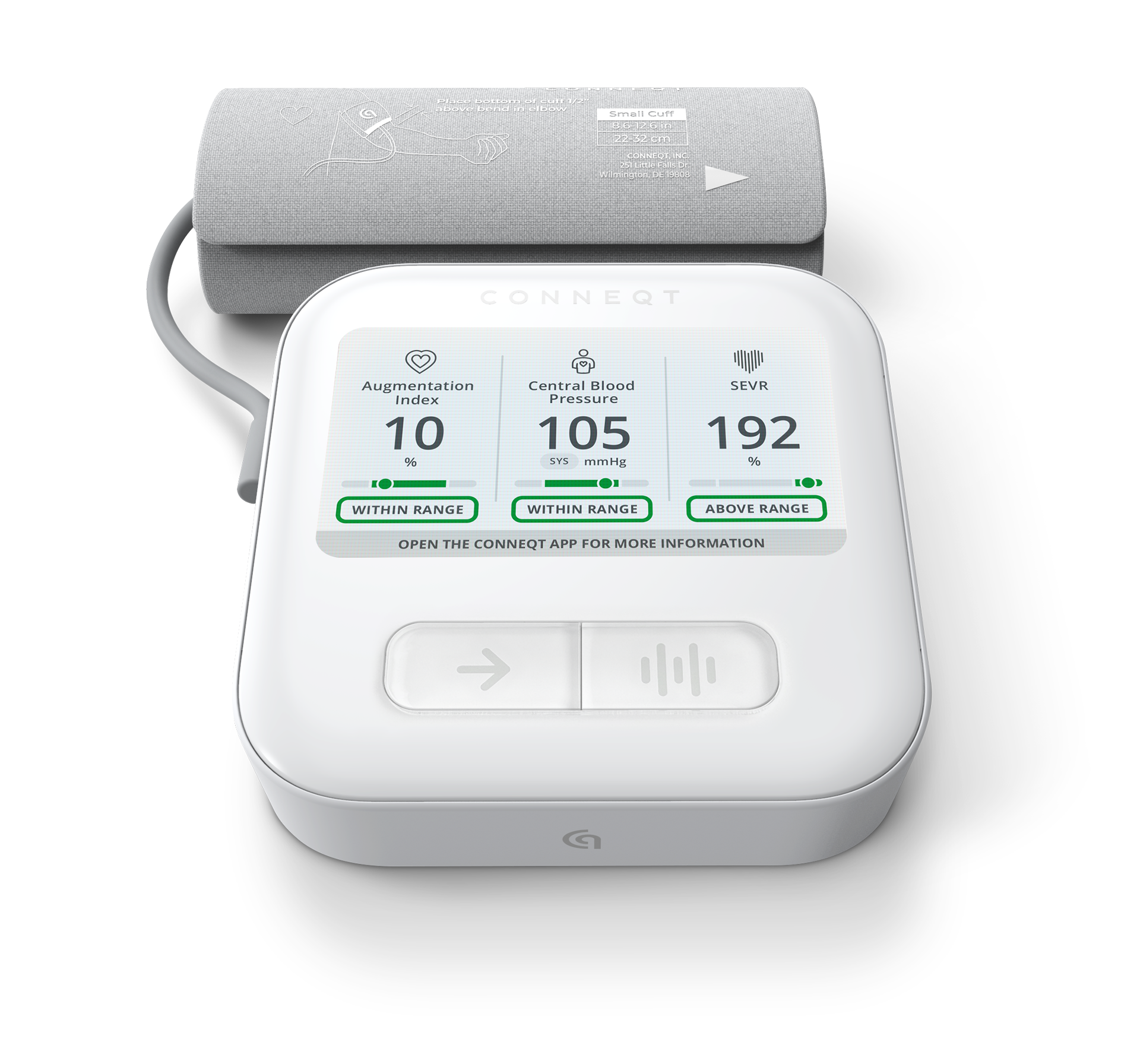
That kind of visibility starts with tracking the right signals consistently. The CONNEQT Pulse tracks central blood pressure and arterial stiffness over time, the same markers the research in this article measures most consistently. Not as a diagnostic tool. As a way to see whether your arterial health is moving in the right direction over time, not just at a single point.
That connection matters: the signals you’re monitoring at home are the same ones the evidence measures.
What to read next
If you want to go deeper, these articles connect directly to what this piece covered:
- How Consistent Exercise Builds a More Adaptable Heart – The science behind cardiac adaptation and why consistent progressive training builds a heart that handles stress better over time.
- Early Signs of Arterial Stiffness: What Changes Before Symptoms Appear – A complete guide to what changes in the arterial wall before symptoms appear and what consistent measurement can reveal.
- When Is Blood Pressure Actually High? – A practical way to think about blood pressure readings, how to re-check, and what patterns are worth following up on.
- Why Your Blood Pressure Readings Fluctuate, and What to Do About It – How to measure consistently and make sense of patterns over time.
Want to explore more heart-health articles? Browse the full library.