

The new ACC/AHA guidelines expand cholesterol screening to include ApoB and Lp(a), push for earlier treatment, and give CAC scores a bigger role in clinical decisions. Here is what you need to know.
In a Heartbeat
- What are the 2026 Guidelines? The ACC and AHA have issued the first comprehensive update to U.S. cardiovascular risk guidance in eight years. LDL cholesterol is still central, but it is no longer the only marker that matters. ApoB, Lp(a), and a redesigned risk calculator that extends your risk estimate 30 years into the future are now formally part of the clinical conversation.
- Why Do They Matter? The guidelines reflect a consistent direction: know more, act earlier, and treat the full picture of risk before it becomes an event. New LDL targets are tied to specific risk categories, CAC scores, which measure calcified plaque buildup in the cronary arteries, now have defined treatment implications, and women’s reproductive history is formally included in standard risk assessment for the first time.
- What to Ask Your Clinician: Has Lp(a) ever been part of your lipid panel? If not, request it. If you are on cholesterol-lowering medication, ask whether ApoB testing also makes sense for you. If the decision about starting treatment is uncertain, ask whether a CAC scan would help clarify it.
The 2026 cholesterol guidelines are out. And if your standard lipid panel has been your only window into cardiovascular risk, the update is worth paying attention to.
This is the first comprehensive update to U.S. cardiovascular risk guidance in eight years. The American College of Cardiology and American Heart Association co-authored the document alongside nine other leading medical organizations.

Medical Grade, Accurate, FDA-Cleared Heart Insights.
Save 10% on checkout with code VITALITY
LDL cholesterol is still central. But it is no longer the only marker that matters. ApoB, Lp(a), and a redesigned risk calculator that extends your risk estimate decades further into the future are now formally part of the clinical conversation.
The core message running through the 2026 guidelines is worth holding onto: according to the guideline authors, 80 percent or more of cardiovascular disease is preventable.
There’s one consistent direction in the updates that follow. Know more, act earlier, and treat the full picture of risk before it becomes an event.
A new cardiovascular risk calculator replaces the old one
If you have ever had a clinician estimate your 10-year risk of a heart attack or stroke, that number was almost certainly generated by the Pooled Cohort Equations, a risk tool in use since 2013. The 2026 guidelines retire it in favor of a more accurate and more complete tool: the PREVENT-ASCVD calculator.
The older tool was known to overestimate risk by 40 to 50 percent in some populations. The new PREVENT calculator removes race as a variable, incorporates kidney health and blood sugar control, and generates both a 10-year and a 30-year risk estimate.
That 30-year number is new and significant. A person in their 40s may look low-risk over the next decade but carry meaningful cumulative exposure over a lifetime. The longer horizon changes the conversation about when to start acting.
The calculator also accepts three optional inputs, including kidney health markers, blood sugar levels, and a neighborhood-level socioeconomic index, that can personalize the estimate further if your clinician has that information on hand.
You can use the ACC’s CVD Risk Estimator Plus before your next appointment and bring the results to discuss with your clinician.
Cholesterol targets are back, and they are more specific
For years, the standard advice was to reduce your LDL cholesterol by a certain percentage. The 2026 guidelines bring back something more concrete: specific LDL cholesterol targets.
LDL-C, the measure of cholesterol carried by low-density lipoproteins and the particle most associated with arterial plaque, now has risk-based goals your clinician will work toward. So does non-HDL-C, which captures a broader set of plaque-contributing particles beyond LDL alone.
The targets depend on your risk category:
- Borderline risk
- PREVENT 10-year risk 3% to <5%
- LDL-lowering therapy may be considered after a clinician-patient discussion
- Intermediate risk
- PREVENT 10-year risk 5% to <10%
- LDL-C goal generally <100 mg/dL
- High risk
- PREVENT 10-year risk ≥10%
- LDL-C goal generally <70 mg/dL
- Very high-risk ASCVD / secondary prevention
- prior cardiovascular event with very high-risk features
- LDL-C goal <55 mg/dL
Notably, the borderline risk category is new. Previous guidelines did not recognize this threshold as a point where treatment was worth considering. Its inclusion reflects the broader shift toward acting earlier rather than waiting for risk to climb.
Statins, the most commonly prescribed medications for lowering LDL-C, remain the first-line treatment for most people. For those who cannot reach their targets on statins alone, the guidelines encourage adding non-statin therapies including ezetimibe, bempedoic acid, or injectable PCSK9 inhibitors rather than waiting.
Knowing your target number gives your next lipid panel more meaning. Instead of wondering whether your result is good enough, you have a specific goal to track against over time.
ApoB testing is now formally recommended
If you have been following cardiovascular research, you may have encountered apolipoprotein B, known as ApoB, as a marker that tells you more about your risk than LDL-C alone. The 2026 guidelines now make testing for it an official recommendation.
LDL-C measures the amount of cholesterol carried by LDL particles. ApoB counts the actual number of atherogenic particles circulating in your blood. Someone can hit their LDL-C target and still carry a high particle count.
ApoB reveals that residual risk in a way LDL-C cannot. Testing is now recommended for people already on cholesterol-lowering medication, particularly those with cardiovascular disease, type 2 diabetes, elevated triglycerides, or low achieved LDL-C.
The reasoning is straightforward: once your LDL-C is being treated, ApoB can reveal whether particle-level risk remains elevated even when your cholesterol numbers look controlled. If you have never had it tested, it’s worth raising with your clinician.
For a deeper explanation of what ApoB measures and why the distinction from LDL matters, this article covers it in detail.
Lp(a) screening is now recommended for every adult
Most people have never heard of lipoprotein(a), known as Lp(a).
Unlike LDL-C, it is almost entirely determined by genetics. Diet, exercise, and standard cholesterol medications have little effect on it. And because it has not been part of routine lipid panels, most people do not know where they stand.
The 2026 guidelines change that. A Class 1 recommendation, the strongest level of clinical endorsement, now calls for every adult to have their Lp(a) measured at least once in their lifetime.
Knowing your Lp(a) level clarifies your baseline genetic risk and informs how aggressively you should manage other modifiable factors, such as LDL-C, blood pressure, and lifestyle. For some people, an elevated Lp(a) is the missing piece that explains why their cardiovascular risk looks higher than their standard labs suggest.
If Lp(a) has never been part of your lipid panel, ask your clinician to include it. For a full explanation of what the test measures, what your result means, and what to do with the information, see our dedicated guide: Lp(a): What The Test Shows and What to Do With the Result.
CAC scores have a bigger role in treatment decisions
The coronary artery calcium scan has long been a useful tiebreaker when the decision about starting cholesterol medication is uncertain. The 2026 guidelines give it a more specific and actionable role, with defined score ranges now tied to defined treatment goals:
- Score of zero: In the right clinical context, supports deferring medication and focusing on lifestyle changes if required
- Score of 1 to 99: Points toward moderate-intensity statin therapy
- Score of 100 to 999: Supports more intensive LDL-C reduction targets
- Score of 1,000 or above: Triggers the most aggressive LDL-C goal, below 55 mg/dL
One meaningful new addition: clinicians are now advised to act on calcium found incidentally on routine chest CT scans, such as those performed for lung cancer screening
The reasoning is straightforward. Coronary calcium visible on any scan represents the same biological reality regardless of why the scan was ordered. If that information exists, the guidelines say, use it.
A CAC scan is a snapshot of calcified plaque on the day you were scanned. It does not tell you what has changed since that day, what is happening in your arteries right now, or how they are responding to the demands being placed on them between clinical appointments.
For more on what a CAC scan can and cannot tell you, this article goes deeper. That distinction shapes how you monitor your cardiovascular health over time.
Women’s reproductive history is now part of standard cardiovascular risk assessment
The connection between reproductive history and cardiovascular risk has been well established in the research for years. The 2026 guidelines aim to ensure that evidence now reaches every patient consistently, formally including reproductive history as a risk-enhancing factor in standard clinical practice.
The following are now part of the cardiovascular risk conversation:
- Early menopause, defined as before age 45
- Preeclampsia or gestational hypertension during pregnancy
- Gestational diabetes
- Preterm delivery
Women who have experienced any of these may have received a risk assessment in the past that did not fully account for their history. That changes with this update.
The guidelines also include updated guidance on managing severely elevated triglycerides during pregnancy, a separate but related development for women managing lipid conditions.
If any of these apply to your history and have not yet come up in your cardiovascular conversations, raising them explicitly at your next appointment gives your clinician the full picture. For more on how cardiovascular risk in women is evolving, this article and this one on menopause and arterial health cover the research in more depth.
Evidence-based diet support is in, cholesterol supplements are out
Many people take supplements specifically marketed for heart health, products like over-the-counter fish oil, garlic, or red yeast rice, believing they are actively managing their cholesterol or triglycerides. The 2026 guidelines are direct on this point: supplements marketed to lower LDL-C or triglycerides are not recommended. The evidence for these specific products reducing cardiovascular risk is limited and inconsistent.
What the guidelines do recommend is personalized dietary support from a registered dietitian, particularly for people with fasting triglycerides above 150 mg/dL or features of metabolic syndrome. One is a product. The other is a strategy built around you.
What you eat remains the foundation. The Mediterranean dietary pattern continues to be well-supported by the evidence for cardiovascular health. For practical guidance on what that looks like, this article on cardiovascular superfoods is a useful starting point.
Putting this into practice
The guidelines are only useful if they change something. Here is where to start.
- Ask about Lp(a) if you have never had it measured. It is now a Class 1 recommendation for every adult at least once. If it has never been part of your lipid panel, request it.
- Request ApoB testing if you are on cholesterol-lowering medication, particularly if you have diabetes, elevated triglycerides, or your LDL-C is already well-controlled. ApoB can reveal particle-level risk that LDL-C alone cannot.
- Consider a CAC scan if the decision about starting medication is uncertain. The new guidelines give specific score ranges direct treatment implications. A scan can move an uncertain decision to a clear one.
- Raise your reproductive history if you are a woman and it has not been part of your cardiovascular risk discussions. Your history matters here. Make sure your clinician has the full picture.
Most of it comes down to one conversation. And that conversation goes further when you arrive with more than a single data point.
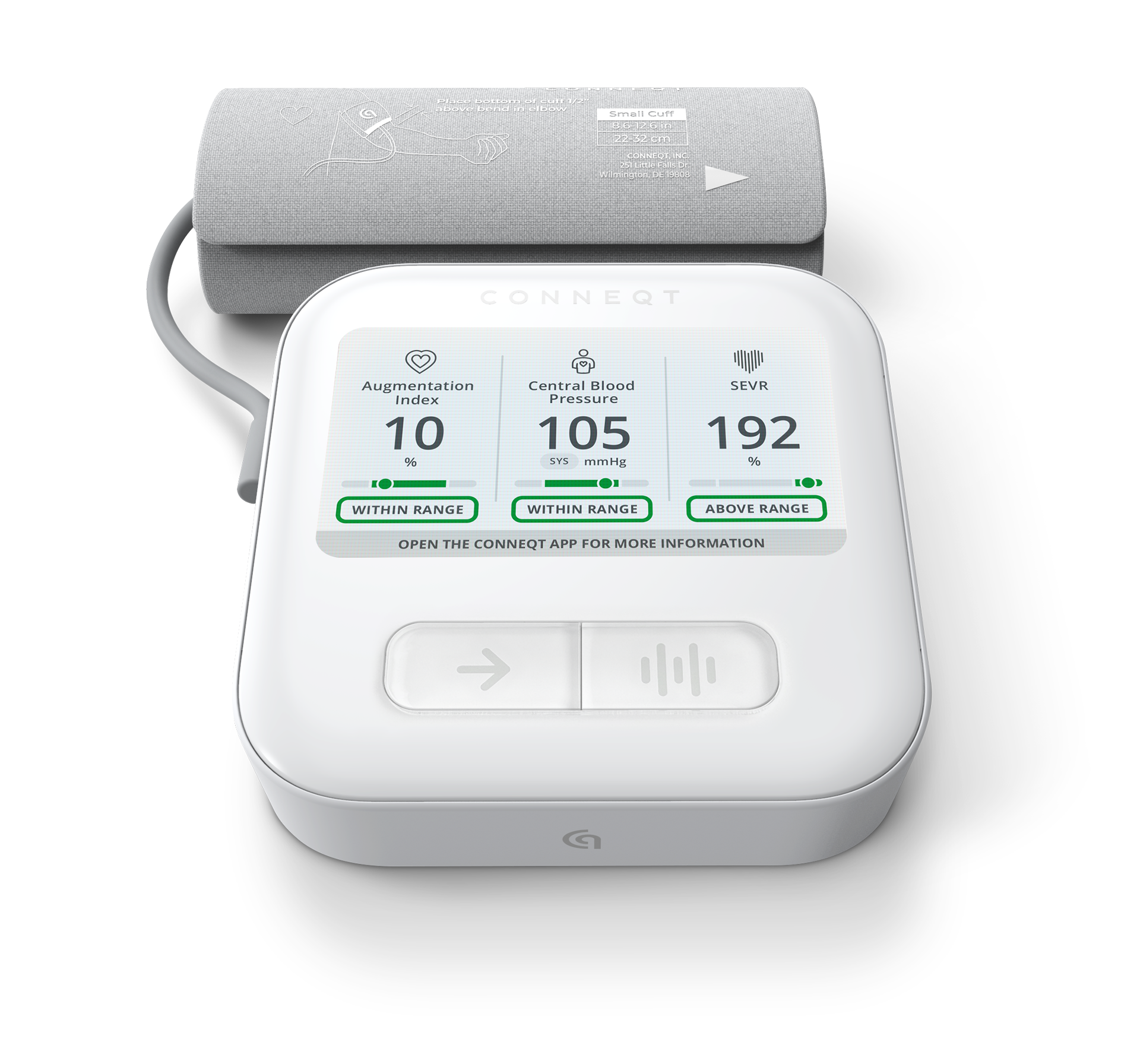
What your clinician measures in the office is one part of the picture. Arterial stiffness and central blood pressure, the functional signals that can shift before structural changes in your arteries appear, are measurable at home between appointments. The CONNEQT Pulse tracks these consistently, adding a layer that lipid panels and imaging alone cannot provide.
For more guidance on bringing these conversations to your next appointment, this article is a practical starting point.
What to read next
Each of these takes one topic further.
- What ApoB Reveals That LDL Misses – Why ApoB gives a more complete picture of cardiovascular risk than LDL-C alone, and what to do if your number is elevated.
- What Your Calcium Score Won’t Tell You – What a CAC scan reveals. What it cannot. And why the distinction matters for how you monitor over time.
- Menopause’s Impact on Arterial Health – How hormonal changes affect arterial function and what the research shows about monitoring during and after menopause.
- Heart Health Insights for Women – A broader look at how cardiovascular risk in women differs and what to watch for.
- 17 Cardiovascular Superfoods – The dietary patterns and specific foods the evidence consistently links to better arterial health.
- How to Read and Use Your Pulse Reports for Better Heart Health – How to interpret the markers your clinician is now more likely to order, and what to do with the results.
More is available in the full library.