

The steepest projected rise in heart disease is among younger women, and it builds quietly, often before symptoms. The bigger takeaway is what to do earlier, before risk becomes disease.
In a Heartbeat
What’s changing: Heart disease is rising fastest in younger women. A new AHA forecast projects nearly 1 in 3 women ages 20 to 44 will have cardiovascular disease by 2050, up from fewer than 1 in 4 today.
Why it’s missed: The early changes are gradual and often silent, and women in their 20s to 40s are the least closely monitored.
What helps: A few tracked signals, a baseline, and watching the trend can surface risk years before symptoms, early enough to act.

Medical Grade, Accurate, FDA-Cleared Heart Insights.
Save 10% on checkout with code VITALITY
If you’ve been seeing more headlines about women and heart health lately, it’s not just a media cycle. It’s a response to a real shift in the underlying risk picture.
A new American Heart Association projection forecasts a sharp rise in cardiovascular risk among U.S. women by 2050. The increases aren’t limited to later decades of life. Some of the steepest are projected for the youngest women: nearly one in three women ages 20 to 44 is forecast to have cardiovascular disease by 2050, up from fewer than one in four today.
Women’s heart risk tends to build quietly, through small changes that don’t always feel significant enough to act on. Because many of those changes don’t come with obvious symptoms, the most valuable move is earlier visibility: a baseline and consistent measurement that lets you spot drift before it becomes a bigger problem.
What the AHA forecast actually says
This forecast is not a prediction about any one person. It’s a population-level model looking at where women’s cardiovascular health may be headed in the U.S. if current trends continue. It uses national data and demographic projections to estimate how common cardiovascular disease and key risk factors could become by 2050.
Projection snapshot (2050):
- Across U.S. women overall, the forecast projects that roughly 6 in 10 will have some form of cardiovascular disease.
- The steepest increases fall on women ages 20 to 44. In that group, the forecast projects:
- Diabetes more than doubling from about 6% to nearly 16%
- More than a third with high blood pressure
- More than 3 in 5 with obesity (roughly 60%, up from about 42% today)
Not every trend moves in the wrong direction. The statement projects improvements in some behaviors (diet, physical activity, smoking), while inadequate sleep is projected to worsen. It’s also important that these trends won’t affect every community equally, and existing disparities may widen without earlier prevention and access.
The takeaway is less about a single headline number and more about direction. The major drivers of heart disease are projected to become more common in women, not less. That includes familiar risk factors like high blood pressure, diabetes, and obesity, and the downstream impact those risks can have over time. The statement also projects increases in conditions like coronary disease, heart failure, stroke, and atrial fibrillation over time.
It helps to read this kind of forecast the right way. It’s not saying “your heart health will get worse.” It’s saying that, across the U.S. population, more women are likely to carry more cardiovascular risk earlier in life, which makes prevention more time-sensitive.
That’s the quiet shift. When risk builds gradually, the advantage goes to people who can spot change early, track patterns, and adjust before it becomes a bigger problem. The challenge is that early risk doesn’t always announce itself, especially in women.
So how does this get missed so often, even when women feel fine?
Why women’s heart risk can be easier to miss
For a lot of women, early cardiovascular risk doesn’t look like a crisis. It looks like life. Stress rises. Sleep slips. Movement becomes less consistent. Weight distribution changes. Blood pressure creeps up, then comes back down. Nothing feels dramatic enough to “count,” so the idea of heart risk stays abstract.
There’s also a mismatch between how many people picture heart disease and how it can show up in women. Popular narratives tend to focus on a single dramatic event and a narrow set of symptoms. But women’s cardiovascular disease can be more complex in how it develops and how it’s recognized. That doesn’t mean women are destined for worse outcomes. It means the early story can be easier to overlook.
And then there’s the baseline problem: many women aren’t monitored closely in their 20s, 30s, and early 40s, when prevention has the most leverage. Women in these years are less likely than older women to have a regular primary care provider, and many delay or skip care because of cost.
Some rely on an OB-GYN as their main link to the health system, and those visits, as important as they are, aren’t usually set up to track cardiovascular trends. So early signs slip by. Uncontrolled high blood pressure is one of the most treatable cardiovascular risks. Yet among young women aged 18 to 44, nearly 7 in 10 don’t know they have it.
Without a baseline, it’s hard to tell the difference between a one-off blip and a trend that’s quietly moving in the wrong direction. That’s the gap consistent measurement is meant to close.
That’s why the “quiet shift” matters. When the early stage is subtle, the advantage goes to visibility, not intuition.
Why “feeling fine” isn’t a signal
Early cardiovascular risk in women can be easy to underestimate because changes often build quietly and don’t feel “classic.”
It can look like nothing more than being tired, busy, and “a little off” for a few months, until a number finally tells the story. A baseline and consistent measurement help you spot drift early, so you can act before it becomes a bigger problem.
The quiet shift is gradual, until it isn’t
For many women, cardiovascular risk doesn’t show up as a single “before and after” moment. It accumulates slowly, through small shifts that are easy to normalize: slightly higher blood pressure more often than it used to be, gradual metabolic drift, changes in sleep and stress that start to take a measurable toll.
That’s why the forecast is so relevant. It isn’t predicting a sudden wave of disease. It’s reflecting a long runway of exposure to the same few drivers, over more years of life. And when those drivers stack up, the outcomes can feel sudden later, even though the path was gradual.
A single checkup can miss that story. One “good” reading can be reassuring, but it doesn’t tell you what’s happening in between. Trends do. Trends show whether your baseline is stable, drifting, or improving.
This is also where prevention becomes practical. When you can see change early, you have options: small course corrections that are easier to sustain and more likely to compound over time. That’s the real advantage of earlier visibility, not perfect numbers.
The goal is not to track everything. It’s to track a few signals consistently enough that you can tell what’s changing, and what isn’t.
What women should watch earlier
You don’t need a long checklist to make this useful. The goal is to pick a few signals that are closely tied to cardiovascular risk, establish a baseline, and then watch how they change over time.
Here are the early signals that tend to matter most.
Blood pressure patterns
One number is a snapshot. Patterns are information. Measure at a similar time each day for a few weeks to establish a baseline, then watch the trend.
There’s also a biological reason to start watching before a reading looks high. Guidelines have long used the same blood pressure targets for everyone, but research shows heart risk in women starts climbing at lower levels than in men. A reading that looks borderline by the standard cutoffs can still carry real risk for a woman.
What matters most is which way your baseline is trending.
Weight and metabolic drift
Cardiovascular risk often follows metabolic drift, not dramatic change. Gradual shifts in weight, waistline, or blood sugar regulation can matter more than a single “good” lab result.
Lipids and advanced markers
Standard cholesterol numbers can look fine while risk is building. If you have access to more advanced lipid testing, ApoB can add helpful context because it reflects the number of cholesterol-carrying particles in the bloodstream. It’s also worth asking your clinician about lipoprotein(a), or Lp(a), an inherited marker most people only need to check once.
Sleep and stress load
Sleep and stress don’t just affect how you feel. They can affect blood pressure patterns, recovery, and the signals that accumulate quietly in the background. If your sleep quality is trending down, it’s worth treating that like a cardiovascular input, not just a lifestyle issue.
Your personal history
Family history matters. So do several factors specific to women that a general risk conversation can miss. Each is linked to higher cardiovascular risk: early menopause, before age 40; polycystic ovary syndrome (PCOS); pregnancy complications such as preeclampsia and gestational diabetes; and autoimmune conditions like lupus and rheumatoid arthritis.
None of these means heart disease is coming. They’re context. The goal isn’t to self-diagnose. It’s to make sure your baseline and follow-up conversations include the right history, so your numbers are read against your full picture.
A simple playbook: baseline, trends, early course correction
The goal here isn’t to turn your life into a monitoring project. It’s to give yourself enough consistency that you can tell what’s stable, what’s drifting, and what’s improving.
1) Establish a baseline
Start by measuring in a repeatable way for a short window of time.
- Pick a consistent time of day you can stick with.
- Keep the basics consistent: seated, rested, and in a calm moment.
- Aim for enough readings over a few weeks to understand what “normal for you” looks like.
2) Track trends, not noise
Blood pressure and other signals naturally move day to day. What matters is direction.
- Look for patterns over weeks and months.
- Pay attention to repeated drift, not one-off spikes.
- If you notice a change, ask: is it persistent, and does it line up with something in your life (sleep, stress, travel, illness, training)?
3) Use context to make the data usable
A baseline becomes more valuable when it’s paired with a small amount of context.
- If a reading is higher than usual, note what was different (poor sleep, caffeine, stress, timing).
- If your trend improves, note what changed, too. That’s how you learn what’s actually working.
4) Adjust early, while the change is still small
Early course corrections tend to be simpler and more sustainable than big interventions later.
- Treat trend movement as information, not a verdict.
- Focus on the basics that reliably move cardiovascular risk: sleep, stress management, movement, nutrition, and follow-up care when needed.
- If a trend stays elevated or continues to drift, bring that pattern, not a single reading, into a conversation with your clinician.
The encouraging part is that, for women, a little goes a long way. In a study of more than 400,000 adults, women got the same heart benefit as men from about half the exercise, roughly 140 minutes a week versus five hours for men. Strength training counts too, and even a single session a week is linked to a meaningful drop in cardiovascular risk for women.
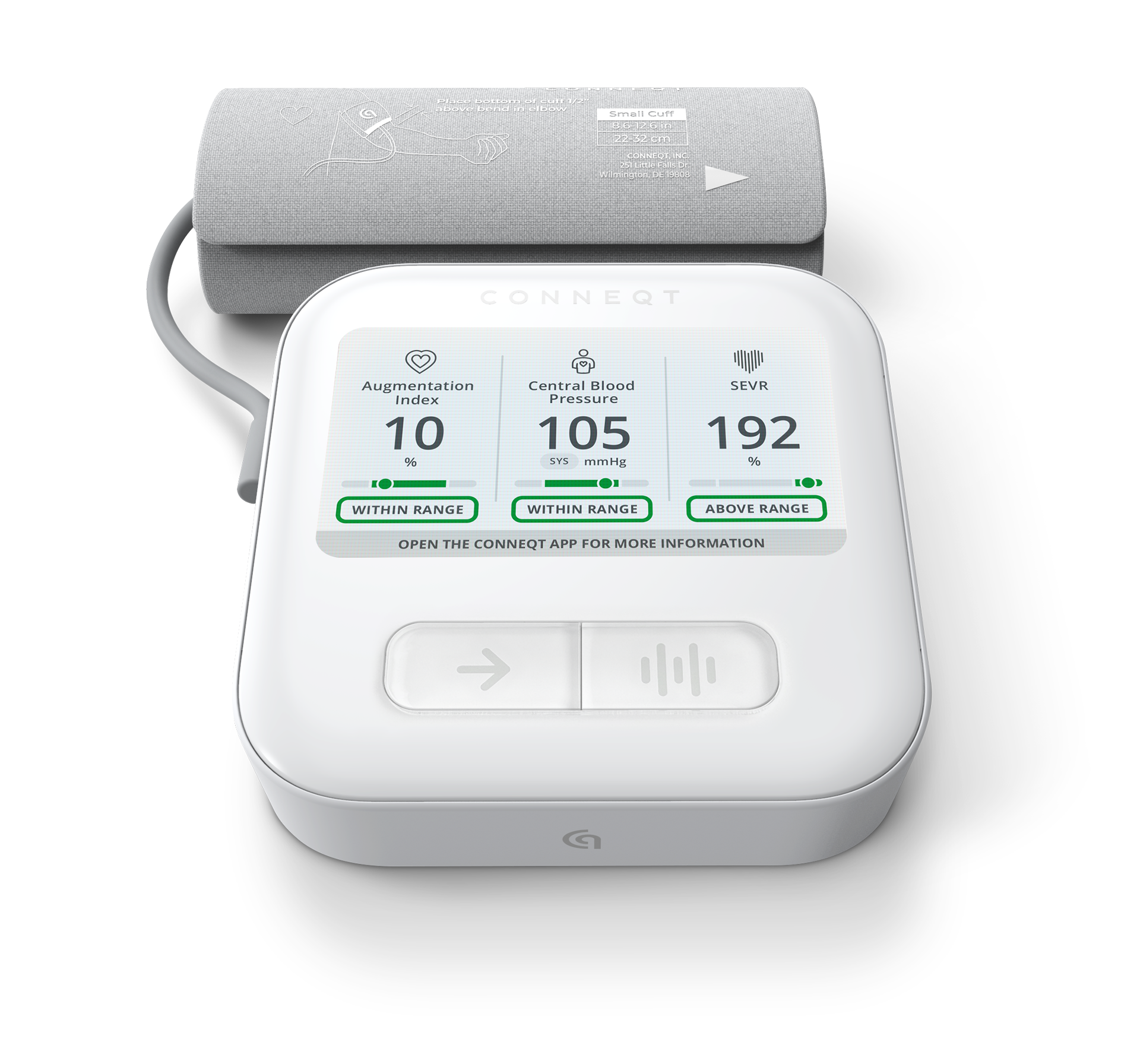
Consistent measurement is the hard part for most people. Tools that help you capture readings reliably and see patterns over time can turn “numbers” into something more useful: context you can act on. CONNEQT Pulse is built for exactly that: consistent at-home readings and trend visibility, not one-off spot checks.
The goal isn’t anxiety. It’s earlier leverage.
If this forecast made you want to “get ahead of it,” the simplest place to begin is a baseline.
Women’s cardiovascular risk doesn’t appear overnight. It builds gradually, often quietly, and the earlier you can see the pattern, the more options you have.
The goal isn’t to obsess over numbers. It’s to build a baseline, watch trends, and adjust early while changes are still small. The earlier you start, the more the data can tell you.
What to read next
If you want to turn this into a plan, start here: the signals that matter most for women, and how to track them.
- How to Get More Consistent At-Home Readings — The practical guide to building a reliable baseline at home, the first step everything here depends on.
- Women Have Hearts Too: The Menopause Conversation We’re Not Having — Why cardiovascular risk climbs around menopause, and what to watch as you approach it.
- Strength Beyond the Scale: How Strength Training Boosts Cardiovascular Health in Women — The kind of movement that pays off most for women’s hearts, and why.
- What Your Coronary Calcium Score Actually Means — What a coronary calcium score shows about plaque that has already formed, and when it’s worth asking your clinician about one.
Want to explore more? Browse the full library.