



Your heart changes in response to what you ask it to do. This guide explains the science behind cardiovascular adaptation and why consistent, progressive training builds a heart that handles stress better over time.
Most people think the key to heart fitness is pushing harder. But the research points to something simpler: training that progresses consistently over time.
Age is part of the story, too. The heart can adapt at any stage, but some changes become harder to reverse later, which is why that pattern matters even more as the years go on.

Medical Grade, Accurate, FDA-Cleared Heart Insights.
Save 10% on checkout with code VITALITY
This guide unpacks what an “adaptive” heart really means, why repeatable training often outperforms random intensity, and what the research behind a well-known training structure says about when and how to train. The goal is clarity, not a prescription.
Exercise strengthens your heart by improving how it fills, pumps, and recovers from effort. These are changes that accumulate gradually over weeks and months.
Start with the simplest truth: the heart responds to what you repeat.
In this article
- What “adaptive” actually means
- The case against “random effort”
- Why this training structure works
- Timing matters: why midlife is a key window
- What the evidence shows in humans
- How to apply these principles
- What to watch as you build adaptation
- Quick recap
- What to read next
The idea: your heart is trainable
Your heart is built to adapt. Not just in the sense of “getting in shape,” but in how it physically responds to repeated demands.
Over time, consistent exercise can change how the heart fills, how much blood it pumps per beat, and how efficiently it supports blood flow under stress. Inactivity pulls those systems in the other direction. Capacity declines, and the body becomes less efficient.
The key point is that adaptation follows exposure. It’s less about one heroic workout and more about the signal you create week after week. When the signal is consistent, the heart becomes more capable and resilient. When it disappears, the gains begin to unwind.
Research from Dr. Levine’s group shows just how quickly cardiovascular fitness can drop with inactivity. Just three weeks of bed rest reduced cardiovascular capacity by 27% in young men, a steeper decline than 30 years of normal aging caused in the same individuals. And structured training restored most of what was lost.
Cardiac plasticity in real terms
This kind of change has a name: cardiac plasticity. It means the heart can remodel. This is about function, not just getting in shape. Chambers can change size. The heart muscle can adjust. The system can become better or worse at filling and pumping depending on what you repeatedly ask it to do.
You don’t need to memorize the physiology to use the concept. The takeaway is simple: a heart that adapts well is built through repeatable training, not occasional intensity.
What “adaptive” actually means
When we say an “adaptive” heart, we don’t mean a heart that can grind through harder workouts. We mean a heart that handles demand well and recovers well.
In real life, that can show up as steadier performance under stress. Your heart can meet a challenge, then settle back toward baseline more efficiently. It’s also why two people can do the same workout and have very different “costs” afterward, even if both look fit on paper.
An adaptive heart isn’t built in a single session. It’s built through repeatable training that gradually asks a little more, while giving the body enough recovery to actually lock in the change.
Three pillars of adaptation
If you want a simple way to think about adaptation, it comes down to three things:
Capacity
This is the amount of work your cardiovascular system can support. It’s often reflected in measures like aerobic fitness, but what matters day to day is whether the same activity feels more manageable over time.
Compliance
This is how easily the heart fills between beats. A more compliant heart can take in blood more efficiently, which supports stronger output with less strain, especially during exercise.
Recovery
This is how quickly your system settles after effort. Better recovery often looks like a steadier baseline, fewer extremes, and more predictable response to the same routine.
These pillars work together. Capacity is what you can do. Compliance helps determine how efficiently your heart can do it. Recovery is how quickly you can return to normal, so the training effect can build instead of breaking you down.
Once you understand what adaptation looks like, the next question is what actually produces it.
The case against “random effort”
It’s easy to assume the secret to a stronger heart is simply working harder. But hard workouts done at random often create a different result than people expect: you may feel wiped out, you may see short-term fitness gains, and you may still fail to build the kind of steady adaptation that holds up over time.
That’s because your cardiovascular system responds best to repeatable signals. Consistency gives your body enough exposure to adapt. Progression gives it a reason to keep adapting. Without that foundation, intensity spikes can become noise.
This doesn’t mean intensity is “bad.” It means intensity works best when it sits inside a pattern you can repeat. Across research reviews, differences between intensity styles are often smaller than people expect, compared with consistency and total training volume.
Intensity matters, but it’s not the whole plan
Hard efforts can improve aerobic fitness. But for many people, some evidence suggests the difference between a heart that adapts and a heart that stalls isn’t one heroic session. It’s the pattern you build across weeks and months.
Consistency builds the base, progression drives change, and recovery is what allows the adaptation to hold.
From there, intensity is a tool. What matters most is whether you can repeat the pattern. If your workouts are sporadic, the first lever usually isn’t “push harder.” It’s “make it repeatable.”
Why this training structure works
If “random effort” is the problem, the solution is not a single perfect workout. It’s a repeatable structure that delivers the right signal over time.
One of the clearest research threads on this comes from Dr. Benjamin Levine, a physician-researcher at UT Southwestern Medical Center who has spent decades studying how the heart changes with inactivity, aging, and structured training. A consistent finding across his work is that the heart remains adaptable, but the stimulus has to be repeatable and progressive for the changes to hold.
One of the most useful takeaways from this body of work is that timing and design matter. Consistent training can improve cardiovascular capacity at any age. But certain structural changes, like how stiff the heart becomes with long periods of inactivity, may be easier to improve earlier in midlife than later. That’s a big reason the “how” of training, not just the fact that you train, matters.
That’s why the training approach behind his work is so useful as a model. It was shaped by research on what happens when the cardiovascular system deconditions, and what it takes to rebuild capacity safely and effectively. The emphasis is not on chasing intensity. It’s on building function first, then gradually increasing load.
At a high level, the logic is simple: start with what you can do consistently, progress in steps, and protect recovery so the adaptation actually holds.
Why starting “easier” first can be smarter
Earlier on in training, the goal is often to build capacity without piling on stress that makes people quit or feel wrecked. That’s also why this training structure can begin with lower-strain formats, including more “horizontal” exercise, like recumbent or seated cardio, before progressing to more upright work.
Reducing upright stress can give the body space to build blood volume and stroke volume, which supports stronger output with less strain. In plain terms: you build the engine before you load it.
The real principle: progression you can sustain
This is not about doing the most. It’s about doing what you can repeat, then gradually asking for more.
A common pattern in structured training is:
- Build frequency and duration first
- Add intensity later
- Use recovery as part of the design, not an afterthought
The payoff is a cleaner signal. Instead of guessing whether exercise is “working,” the body gets repeated exposure, and adaptation has a chance to accumulate.
Timing matters: why midlife is a key window
It’s tempting to think the heart will adapt the same way at any age if you just work hard enough. The reality is a bit more nuanced.
Exercise can improve cardiovascular capacity at every stage of life. But some structural changes tied to long periods of inactivity, especially increased stiffness in the heart, may become harder to meaningfully reverse later on. That’s one reason researchers pay so much attention to timing.
In Dr. Levine’s research, “midlife” is less a cultural label and more a physiological window. In sedentary adults, left-ventricular stiffening becomes clearly apparent around 50–64, which is why that range is often treated as a high-value time to intervene with consistent, progressive training.
The takeaway isn’t “it’s too late” after that point. Studies in adults older than 65 still show meaningful gains in fitness and vascular function, even if cardiac stiffness itself doesn’t reverse as much as it can earlier.
This is about realistic expectations, not a deadline.
Research on lifelong endurance athletes, sometimes called masters athletes, offers one of the clearest pictures of what consistent training can produce over time. Their heart compliance and function can remain comparable to that of healthy adults decades younger. Not because of genetics alone, but because of a repeatable pattern sustained over years.
The middle-age opportunity
This is less about a specific birthday and more about how long stiffening has been in motion. The earlier you build a repeatable pattern, the more runway your heart has to remodel and adapt.
If you’re in midlife, the most strategic approach is not chasing the hardest workout. It’s building a pattern you can sustain long enough to create real change. That means starting with consistency, progressing gradually, and treating recovery as part of the design from the beginning.
At any age, a repeatable structure pays off by improving capacity, tolerance, and how your system responds to stress over time. The window may shift, but the principle doesn’t.
What the evidence shows in humans
The reason Dr. Levine’s work is so often cited is that it doesn’t just argue that the heart is adaptable. It tests that idea in people, over time, using designs that can detect real structural and functional change. This includes classic invasive studies comparing lifelong exercisers with sedentary peers.
Across these studies, a few themes show up consistently. You can improve capacity relatively quickly, but deeper remodeling tends to take longer. Progression matters. And the strongest changes tend to show up when training is sustained long enough to become a true signal, not a short burst.
What changes in months vs. a year (and sometimes longer)
In the first few months of consistent training, it’s common to see improvements in aerobic capacity and how efficiently your body moves blood and oxygen during effort. That’s the “feels better” phase many people notice.
Structural change tends to be slower. In a study that followed previously sedentary younger-to-midlife adults through a full year of progressive endurance training, researchers saw measurable remodeling over time, not all at once.
And in the middle-age research, focused on stiffness-related change, the intervention window was longer. In the randomized trial that tested this directly, the training period was two years, which is part of the point: deeper adaptation often requires sustained, progressive exposure, especially in the 50–64 window we discussed earlier.
What this does not prove
It’s important to be clear about what these studies do and do not show.
They show that the cardiovascular system can improve in measurable ways with consistent training, and that some features of cardiac function and structure can shift when the stimulus is sustained and progressive.
They do not guarantee outcomes for every person, and they are not a promise that exercise “prevents” any single disease. It’s also worth noting that much of this research has been conducted in predominantly white, middle-aged populations, so the findings may not apply equally across all groups.
The value of this research is that it clarifies what tends to improve, what tends to take longer, and why the training pattern matters: consistency, progression, and recovery are what turn effort into lasting adaptation.
How to apply these principles
The science is useful, but only if it translates into something you can actually do. The takeaway here is simple: the heart adapts to what you do consistently.
So what does consistent, progressive training look like in real life? It looks like a routine you can repeat, built around gradual progression and enough recovery to let the change stick.
Three concepts to borrow
Start where you can be consistent
The best routine is the one you can do again next week. Start with something realistic, then build from there. If your routine is so intense you can’t sustain it, it stops being a stimulus and starts being noise.
Progress gradually
Adaptation comes from a routine that slowly increases over time. That can mean a little more time, a little more frequency, or a little more challenge, but not all at once. The goal is steady progression you can maintain.
Treat recovery as part of the design
Recovery isn’t what happens when training ends. It’s part of how training works. Day to day, that can look like spacing harder sessions out, protecting sleep, and taking truly easy days when your body needs them, so you can keep training consistently instead of falling into stop-start patterns.
A simple way to add intensity
Some people use 4×4 intervals, often called Norwegian 4×4 (a training method developed and widely studied in Norway for cardiovascular benefit), as a simple way to add harder effort. It means alternating short “hard” intervals with recovery, using something like a treadmill, bike, or rower.
A common version used in research is four rounds of 4 minutes of harder effort followed by 3 minutes of easier recovery. The exact format matters less than the bigger pattern: consistency, gradual progression, and enough recovery to sustain it. Adjust the effort and timing to your current fitness and recovery.
What to watch as you build adaptation
You don’t need perfect data to see progress. Over time, adaptation shows up as trends: a steadier day-to-day “usual range” (how your body typically runs), better recovery, and more capacity for the same effort.
The goal is clarity without anxiety. A few consistent measures can act as feedback, not judgment. You’re not grading a single workout or a single day. You’re watching how your system behaves across weeks, so you can see direction and adjust with confidence.
Blood pressure patterns as a practical signal
One of the most practical signals to track during a training block is blood pressure, because it’s accessible and it often reflects how your system is handling stress, recovery, sleep, and routine.
Rather than reacting to one reading, watch for a steadier pattern over time. For many people, progress looks like fewer big swings and a more stable “usual range,” especially when measurement conditions are consistent.
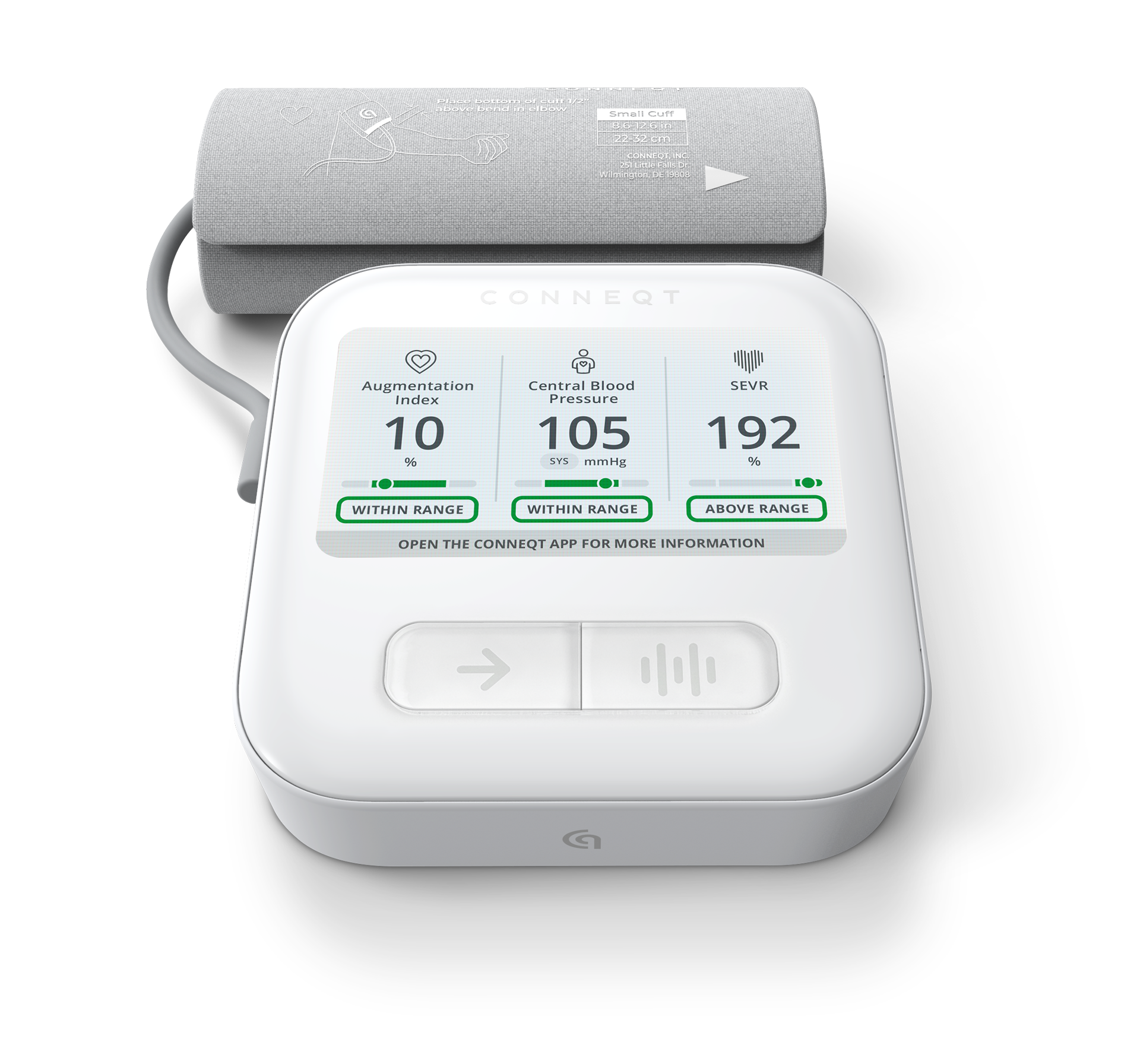
Home measurement over time can help close that gap. The CONNEQT Pulse goes beyond pressure measured at the arm to track the deeper arterial signals that reflect how your cardiovascular system is actually responding to training over time.
For people building a structured routine, that distinction matters. A number from a standard cuff tells you what your blood pressure is in that moment. Central blood pressure and arterial stiffness give you a window into how your heart is actually handling the load.
If you want a simple framework for why readings fluctuate and how to measure more consistently, start here: Why Your Blood Pressure Readings Fluctuate, and What to Do About It.
Want to go deeper? Track heart stress too.
As your cardiovascular fitness improves, one signal worth watching is heart stress. It measures how efficiently your heart supplies itself with oxygen during effort. The CONNEQT Pulse tracks this alongside six other key heart health metrics, giving you a more complete picture of how your heart is adapting to training over time.
Quick recap
If you remember one thing from this guide, make it this: an adaptable heart is built through consistent input over time, not occasional intensity.
- Adaptation is functional. It’s about how well your heart handles demand and recovers, not just how “fit” you feel.
- Consistency creates the base. Random effort can feel productive, but repeatable patterns drive change.
- Progression is the lever. The stimulus has to gradually increase to keep adaptation moving.
- Recovery is part of the design. It’s what allows the change to stick instead of turning into stop-start fatigue.
- Timing matters. Midlife is a particularly valuable window to build adaptation that holds up, but improvements are possible at any age.
If you build a routine you can repeat, the data becomes clearer, the response becomes more predictable, and the work starts compounding.
What to read next
If you want to go deeper, here are a few good next reads, from interpreting daily numbers to understanding what “normal” really means.
- Why Your Blood Pressure Readings Fluctuate, and What to Do About It – How to measure consistently and make sense of patterns over time.
- When Is Blood Pressure Actually High? – A practical way to think about “high,” how to re-check, and what patterns are worth following up on.
- Why 120/80 Is a Clinical Reference, Not Just a Number – What 120/80 actually represents and why it’s a reference point, not a personal scorecard.
- Why Your Arteries Hold the Key to a Longer, Healthier Life – A bigger-picture look at arterial health and why it matters for prevention.
Want to explore more heart-health articles? Browse the full library.