


You can have an excellent VO2 max and a heart that still isn’t keeping itself well supplied with oxygen. That’s the gap SEVR measures, and why you want to track both.
In a Heartbeat
The distinction: VO2 max measures how much oxygen your body can use. SEVR (subendocardial viability ratio) measures whether your heart is supplying itself with enough oxygen. They answer different questions.
The catch: A high VO2 max does not guarantee a healthy SEVR. The two don’t always move together.
The evidence: One 2025 study of 3.8 million people tied each 3.5-point VO2 max gain to about 14% lower risk of dying. A lower SEVR is linked to higher cardiovascular risk.
What to track: Both, and watch how each one trends over time.
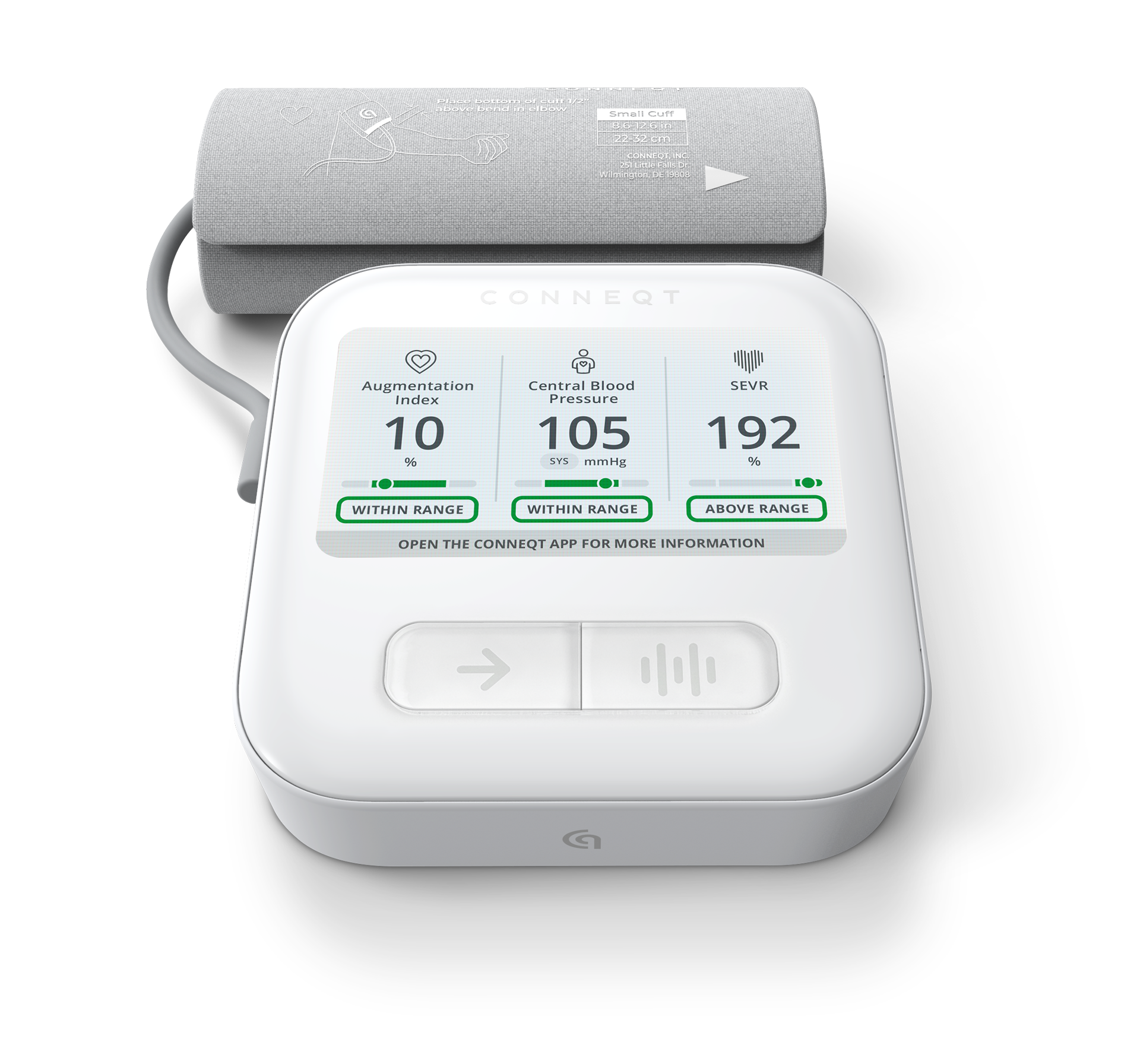

Medical Grade, Accurate, FDA-Cleared Heart Insights.
Save 10% on checkout with code VITALITY
Most fitness tracking measures effort. How hard your heart beats, how much oxygen your muscles use, how fast you recover. VO2 max is the one people chase hardest.
None of these numbers answer a more basic and important question. Is your heart taking care of itself?
That question has its own metric, and fitness trackers and wearables never surface it.
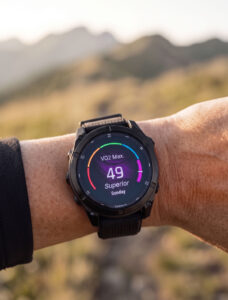
Before I get to that metric, here’s the case for VO2 max. I watch mine too. My Garmin Fenix 8 currently estimates it at 49, which is in the “superior” range for a man my age (63). That number is the most oxygen my body can take in and use when I’m working flat out. The higher it climbs, the bigger my theoretical aerobic engine.
The science backs it up. Across large populations, fitter people tend to live longer. One 2025 analysis pooled 3.8 million people. Each roughly 3.5-point gain in VO2 max was linked to about 14 percent lower risk of dying from any cause. Most of that evidence comes from men. Fitness helps women here too, but the exact link is less settled and may differ by sex. The American Heart Association has argued fitness belongs beside blood pressure and cholesterol as a vital sign, because it can out-predict both.
So I trust my VO2 max. But I stopped treating it as the whole story.
It tells me how much oxygen my body can use. It does not tell me whether my heart is getting enough of its own.
What VO2 max leaves out
Here’s what VO2 max actually measures. Your heart pumps blood. The blood carries oxygen. Your muscles pull it out and use it.
VO2 max is the ceiling on that chain. What usually sets it is how much oxygen your body can deliver to the working muscles.
Notice what that leaves out. VO2 max measures the oxygen reaching your muscles. The heart is the pump that moves it, not the thing being measured.
But the heart is a muscle too. It has its own arteries. It needs its own oxygen. And a VO2 max score says nothing about whether it’s getting it.
That’s not a technicality. One study made it real.
Researchers scanned the arteries of lifelong endurance athletes. Men with training histories and VO2 max scores most people will never reach. They found more coronary plaque in those athletes than in fit, healthy people who trained far less.
The fitness was real. But it did not keep their arteries clean.
That is the limit of a high VO2 max. It tells you your engine is powerful. It does not tell you whether your heart is taking care of itself.
The other half: what SEVR measures
There’s a number that does. It’s called SEVR, short for subendocardial viability ratio. I watch it beside my VO2 max.
The name is clinical. The idea is simple.
Your heart works in two phases. It squeezes to push blood out. That’s systole. Then it relaxes to fill again. That’s diastole.
Most muscles get their blood supply while they work. The heart is the opposite. It supplies itself in the pause between beats, when it relaxes. Cardiologists call that supply “coronary perfusion”.
Diastole, that pause, is the heart’s supply window. The harder and faster the heart works, the shorter that window gets.
SEVR measures the balance. How well the heart is supplied against how hard it is working. Supply against demand.
The name points to what is most at stake. The subendocardium is the innermost layer of the heart muscle, and the most vulnerable when supply runs low. SEVR tracks how well that layer is kept supplied.
A high SEVR means supply runs comfortably ahead of demand. A low SEVR means that margin has shrunk, and the heart has less to spare.
None of this is new. The physiology goes back to the 1970s. Researchers named the supply-and-demand ratio behind it the Buckberg index, and have used it ever since to gauge how well the heart is supplying itself. What’s new is that it no longer takes an invasive test. It can be read from the shape of your pulse wave.
Think of it like a car. Your heart is the engine. VO2 max tells you how fast you can go. SEVR tells you whether the engine is getting enough fuel to hold that pace without straining.
VO2 max vs SEVR, side by side
Put the two numbers next to each other, and the difference is easy to see. They’re not rivals. They answer different questions.
| VO2 max | SEVR | |
|---|---|---|
| What it measures | The most oxygen your body can use at your limit | Whether your heart is supplying itself with oxygen |
| The question it answers | How much can you do? | Is your heart taking care of itself? |
| How it is measured | Fitness tests; many wearables estimate it | The shape of your pulse wave in your arteries |
| A strong number means | A big aerobic engine | The heart is well supplied for its workload |
| What it misses | Whether the heart supplies itself | How much your body can do |
One measures what you can do. The other, whether your heart can keep doing it. You want both.
They often track together. Not always. And where they part ways is the point worth understanding.
Fitness and SEVR: where they meet, and where they don’t
Start with the good news. Fitter people tend to have stronger SEVR.
In one study, young competitive rowers had markedly higher SEVR than recreational rowers and men active in other sports. In another, across hundreds of adults, higher fitness tracked with higher SEVR.
So training and a well-supplied heart do tend to go together. That’s real, and it is worth knowing.
But “tend to” is not “always.”
Fitness and SEVR are related, not identical. They’re independent measures, and the link between them is loose enough that one can be strong while the other isn’t.
So a high VO2 max does not guarantee a healthy SEVR.
SEVR is shaped by more than training. Age, arterial stiffness, and metabolic health all pull on it. In one study, women in the early years of type 2 diabetes already had the lowest SEVR of any group measured.
That’s the part worth sitting with. You can train hard, post a strong VO2 max, and still have a heart that isn’t keeping itself as well supplied as you would assume.
It’s something to take seriously. I’ve been surprised by my own numbers before. Fitness is not a free pass.
SEVR, aging, and stiffer arteries
Age is the one force you can’t train away. SEVR falls as we get older, and that part is expected.
The reason is arterial stiffness. Young arteries are elastic. They stretch with each beat and recoil to help push blood along. With age, they stiffen.
That stiffening is gradual. Arteries don’t flip from elastic to rigid. They lose their give by degrees, over years.
As they stiffen, the pressure wave from each beat bounces back sooner and stronger. That makes the heart work harder when it pumps, and it leaves less pressure behind when the heart relaxes to refill.
Remember, the heart supplies itself during that refill. So stiffer arteries mean more demand and less supply. SEVR falls.
The research bears this out. In a large group of older adults, a lower SEVR went hand in hand with stiffer arteries. And when stiffness eased in one study, SEVR rose alongside it. The two move together.
None of us escape this entirely. Arteries stiffen with age, mine included. Training helps. But it does not stop it.
Which raises the real question. If SEVR drifts down as arteries stiffen, does a lower number actually matter?
What a lower SEVR is linked to
It does matter. But the honest answer has two parts.
The first part is well established. A lower SEVR is linked to higher cardiovascular risk. It shows up alongside the things cardiologists already watch for: higher blood pressure, higher long-term risk scores, more strain on the heart. Across study after study, that link holds.
The second part is narrower. A lower SEVR has also been linked to a higher risk of dying. But that evidence comes mostly from older adults and people already at higher risk, and even there, how strong the link is varies. Lower always points the wrong way. How much it matters differs from one group to the next.
So a low reading is not a verdict. It tells you roughly where you stand, not a line you have crossed. And it cannot tell you how long you have.
A lower SEVR is a signal. And unlike plaque quietly building in an artery, it is one you can actually see.
That is what makes it worth tracking.
Not one reading, but the direction it moves over time. A SEVR that holds steady as you age is reassuring. One drifting down faster than expected is a reason to look closer and check in with your clinician.
How to read it, and why the trend is the point
You can now track SEVR at home with the CONNEQT Pulse. It comes as part of the same reading that takes your blood pressure, with no extra step.
There’s no single “good” SEVR to aim for. The healthy range shifts with age, sex, and overall health, so the same number can mean different things for different people.
Rather than leave you to read a figure cold, the Pulse puts your result in context, showing SEVR as Above Range, Within Range, or Below Range. What you’re watching is where you land and which way it trends, not a target to chase.
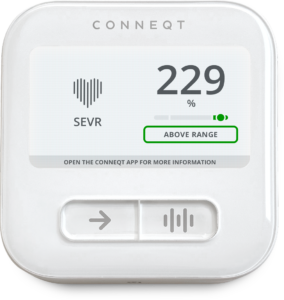
SEVR fills a gap your fitness numbers leave open. Your wearable can show your VO2 max climbing. A SEVR reading shows whether your heart is keeping itself supplied while you push it. Read side by side, they tell you both halves of the story.
A single reading is a useful snapshot. But SEVR earns its keep over time. Take regular readings, watch the direction, and you can see something your fitness tracker can’t show you: whether your heart’s own supply is holding up as you age.
That’s how I use mine. Not to diagnose, but to catch a change early, while there’s still time to ask why.
So, which matters most?
Both. Not one over the other.
Each measures what the other misses. VO2 max tells you how much your body can do. SEVR tells you whether your heart is keeping itself supplied while it does. One is about power. The other is about supply.
A high VO2 max is worth chasing. But don’t mistake it for the whole picture. A strong engine still needs fuel.
That’s the half most people never see. The fitness world has taught us to watch what our bodies can do. It’s said almost nothing about whether the heart is taking care of itself.
So I stopped choosing. I read the two together, because they answer a fuller question than either can alone. How fit am I, and is my heart keeping up.
That is what matters most. Not one number alone. The whole story.
What to read next
If this changed how you read your fitness numbers, here are three places to keep going.
- What Is SEVR? Understanding Subendocardial Viability Ratio – The full definition, including the healthy range and the math behind the number.
- Your Fitness Level and Your Cardiovascular Health Are Not the Same Thing – How someone can be genuinely fit and still carry cardiovascular risk.
- The Best Exercises to Improve Arterial Health – Which kinds of training help your arteries stay elastic.
Want to go deeper? Browse the full library.