
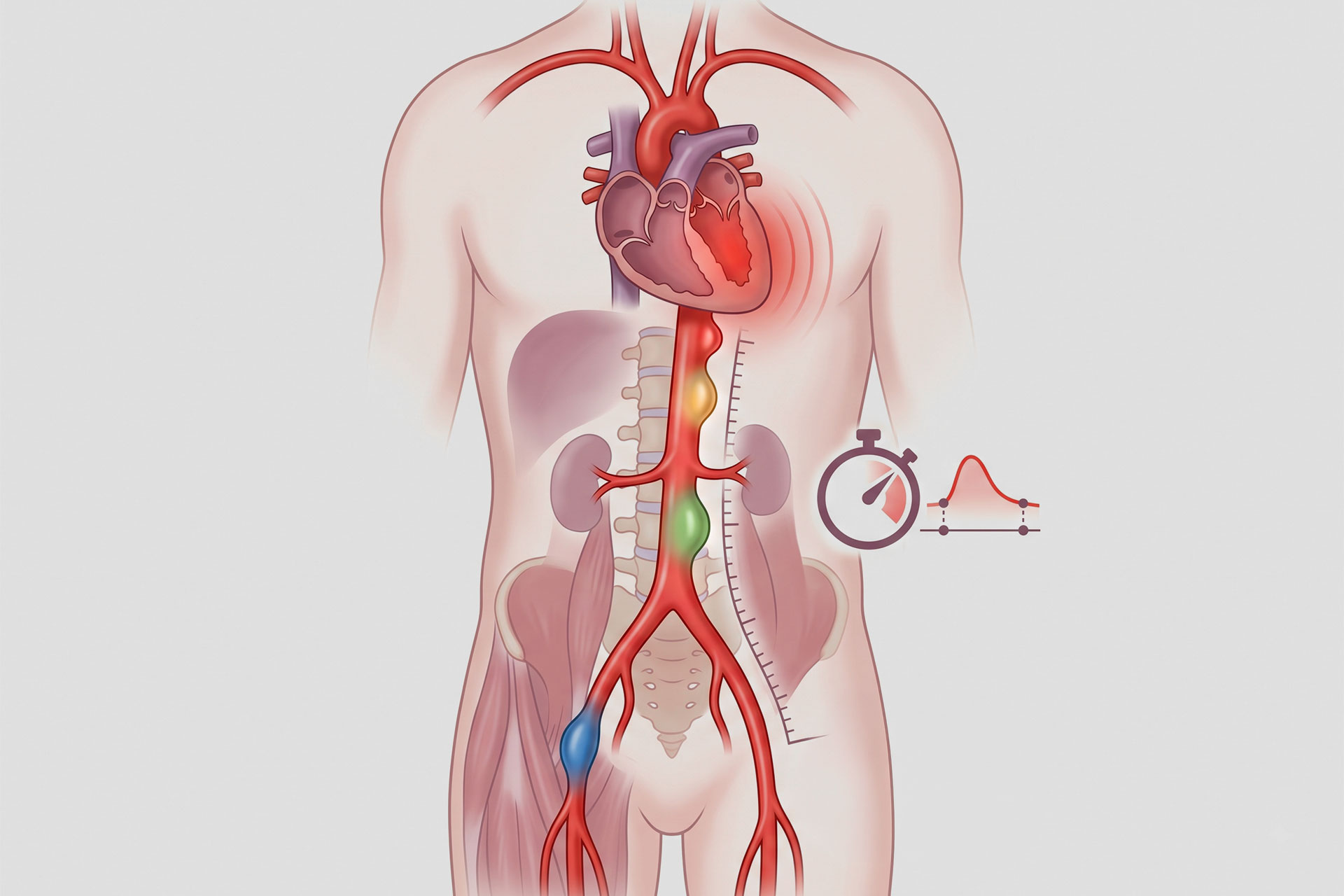
Your arteries stiffen with age, often years before your blood pressure changes. Pulse wave velocity is the number that catches it first, and the closest thing medicine has to a read on how your arteries are aging.
In a Heartbeat
What it is: The speed the pressure wave travels through your arteries. Faster means stiffer. It is the gold-standard measure of arterial stiffness.
Why it matters: It rises with age and predicts cardiovascular events, often before blood pressure changes.
The catch: It is rarely measured in routine care, because measuring it the standard way has always meant two measurement sites on the body and specialized equipment in a clinic.
How to track it: You do not need to go to a clinic. The Pulse is a noninvasive tool that tracks your arterial stiffness at home.
You can track more about your heart from home than ever. Blood pressure, resting heart rate, even an ECG from your watch.

Medical Grade, Accurate, FDA-Cleared Heart Insights.
Save 10% on checkout with code VITALITY
But one of the earliest changes in an aging cardiovascular system doesn’t show up on any of them.
That change is the stiffening of your arteries. It happens quietly, over years, and it often begins before your blood pressure or your usual numbers give any sign of it. There is one measurement clinicians treat as the gold standard for how far that stiffening has progressed.
Most people have never heard of it.
It is called pulse wave velocity, or PWV. Until recently, the only way to measure it was in a clinic or a research lab, which is the real reason it has stayed off your radar. That is starting to change.
In this article
- Why cardiologists pay attention to it
- It rises before your blood pressure does
- The most direct of the stiffness measures
- Why you’ve probably never heard of it
- How you can track your arterial stiffness at home
- What this means for you
What pulse wave velocity actually measures
For a lesser-known metric, it measures something surprisingly simple.
Every time your heart beats, it sends a pressure wave traveling down your arteries. Pulse wave velocity is how fast that wave moves, measured in meters per second.
The speed depends on the artery. A young, elastic artery is like a new garden hose: it flexes with each pulse and cushions the surge, which slows the wave. A stiff artery is more like an old hose gone hard, with little give, so the surge travels through faster. The stiffer your arteries, the higher your pulse wave velocity.
That is what makes it useful. It reads the property that matters most in an aging artery, how much give it has left, and turns it into a single number.
Some of that stiffening is a normal part of aging. The elastin that lets arteries stretch begins to fray, and stiffer collagen takes its place. There’s more to what drives arterial stiffness, but this is the part that shows up in the wave.
Of all the ways to gauge arterial stiffness, pulse wave velocity is the most direct. It doesn’t infer stiffness from something else, it measures the thing stiffness actually changes, the speed of the wave. That is why it is treated as the reference standard.
Why cardiologists pay attention to it
Stiff arteries can sound like a description, a fact about your body. Pulse wave velocity does more than describe. It predicts.
In large studies that followed people for years, those whose arteries were stiffer, with a higher pulse wave velocity, went on to have more heart attacks and strokes, and a greater chance of dying in the years that followed. The stiffer the arteries, the greater the risk that showed up down the line.
The striking part is what it adds. Higher pulse wave velocity predicted risk on top of the standard measures: your blood pressure, cholesterol, and the other usual numbers. It tells clinicians something those numbers, on their own, cannot.
That something is accumulated strain. Stiffness is the wall of the artery keeping a record of every pressure cycle it has weathered, and that record turns out to be one of the clearest signals of cardiovascular risk we have.
It rises before your blood pressure does
Blood pressure gets all the attention, and for good reason. But it tends to be a late signal.
By the time a cuff gives a high reading, the stiffening underneath has usually been building for years. Arteries lose flexibility slowly, and pulse wave velocity climbs with age even in people whose blood pressure still looks normal.
The order matters. In long-running research, stiffer arteries often came first, and they helped predict who would go on to develop high blood pressure later. Stiffness wasn’t only a consequence of hypertension. In many people, it was a warning that arrived before it.
That is what makes it an early signal. It reflects a change already underway while the numbers you do track still look fine.
The most direct of the stiffness measures
Pulse wave velocity isn’t the only way to look at arterial stiffness. If you’ve spent any time learning about heart health, you may have run into others, like augmentation index, central blood pressure, or pulse pressure amplification.
They are all looking at the same underlying question, how stiff your arteries have become, from different angles.
Having several isn’t redundant. Each catches a different facet of how your arteries are behaving, which is why a thorough look at arterial health draws on more than one.
Where they differ is how directly they get at stiffness itself. Augmentation index reads the echo of the pressure wave as it bounces back through the arteries, which reflects stiffness along with other things about how blood moves. Central pressure and pulse pressure amplification capture the pressure your heart and organs actually see. Each measures something real, and each has its place.
Pulse wave velocity gets at stiffness most directly. It measures the speed of the wave, which rises in step with stiffness, and that is why it serves as the reference the others are compared against.
Why you’ve probably never heard of it
By now the picture is clear. Pulse wave velocity predicts heart attacks and strokes, shows up years before your blood pressure does, and measures stiffness more directly than anything else. You would expect it to be standard. It isn’t.
The barrier is access, not safety. Measuring it the standard way is completely noninvasive, but it means reading the wave at two points on the body, usually the neck and the upper thigh, and timing how long it takes to travel between them. That takes specialized equipment and a trained operator, which has kept it inside cardiology clinics and research labs.
None of this means the number is obscure to specialists. Cardiologists and researchers have relied on it for years. It simply never made the jump to the routine check-up, or to public awareness. That is how a metric this useful stays one most people have never heard of.
That gap is what’s starting to close. You no longer need a clinic to track your arterial stiffness.
How you can track your arterial stiffness at home
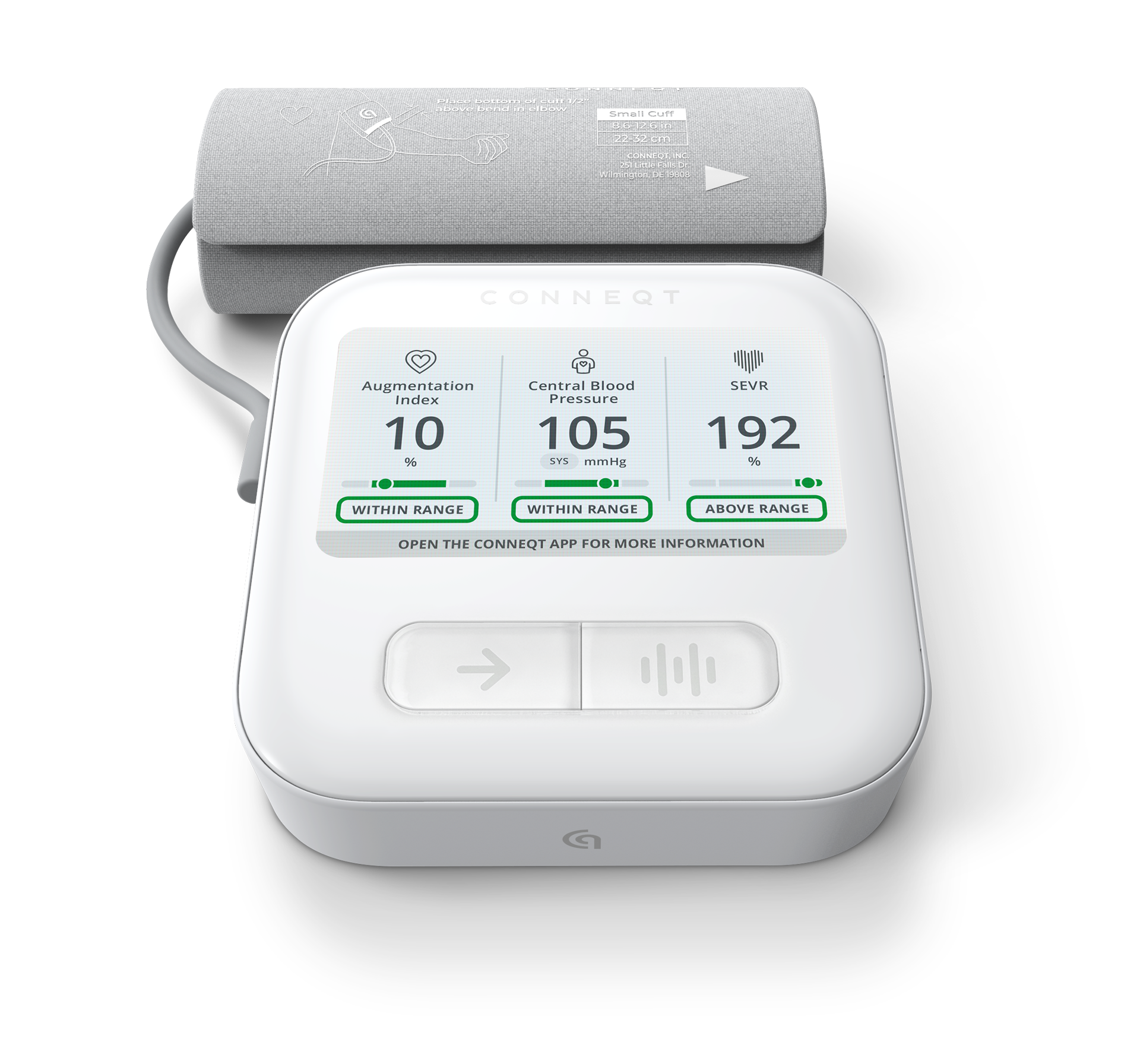
The CONNEQT Pulse changes that. It tracks your arterial stiffness at home, no clinic and no specialist needed.
It goes on just like an ordinary blood pressure cuff. What sets it apart is what happens during the reading. It captures the shape of your pressure wave, a technique called pulse wave analysis. From that waveform, CONNEQT’s algorithm, built on more than 20 years of data, estimates your pulse wave velocity and uses it to produce the arterial markers you see, from central blood pressure to augmentation index.
So you won’t find a pulse wave velocity number on your screen. PWV works in the background, as part of how those markers are calculated. What you see is the result.
That only matters if the results can be trusted. The Pulse is FDA-cleared, and when its markers were compared against the clinical reference device, they agreed.
From there, the value isn’t in any single reading. It’s in the trend. Tracking your arterial stiffness over months and years shows which way your arterial health is trending, early enough to act.
What this means for you
Arteries stiffen with age. That part is normal. What matters is the trend, not a snapshot.
For a long time, that trend was invisible. The clearest early sign of arterial aging sat behind specialized equipment in a clinic. Now you can follow it at home and see which way it’s moving, often before your blood pressure rises and long before any symptoms appear.
That is the whole point. Not fear, and not another thing to obsess over. Just a clearer view of a change that has been quietly underway all along, caught early enough that the habits known to help, like exercise and diet, still have the most room to work.
You’ve now heard of it. And the earlier you catch it, the more you can do about it.
What to read next
Now that arterial stiffness is on your radar, here’s where to take it next, what changes early, and what actually helps.
- Early Signs of Arterial Stiffness: What Changes Before Symptoms Appear — A closer look at what stiffening arteries change first, and why you won’t feel any of it.
- Why Arterial Stiffness Doesn’t Wait for High Blood Pressure — Why stiffness often comes first, and what that means for catching risk before your blood pressure climbs.
- How Long Does It Take to Improve Arterial Health? — If you want to act on the trend, what the research says about how quickly arteries respond, and to what.
- The Best Exercises to Improve Arterial Health — The specific kinds of movement that help arteries most, and why not all exercise counts the same.
Want to explore more? Browse the full library.