

A home blood pressure monitor is only as useful as the technique behind it. Small errors in preparation and positioning can throw your readings off by more than you might expect. Here is how to get it right.
In a Heartbeat
What it is: Home blood pressure monitoring means taking regular readings outside a clinical setting using a validated upper arm cuff device. Done correctly, it gives you a more reliable picture of your cardiovascular state than a single office visit can provide.
Why it matters: Small errors in technique produce readings that are significantly off. Arm position alone can overestimate systolic pressure by more than 6 millimeters of mercury. The wrong cuff size can push that error to nearly 20.
How to get it right: Rest for five minutes before measuring. Use a validated upper arm cuff that fits your arm. Support your arm on a flat surface at heart level. Take two readings per session, morning and evening, for at least seven days.
What to track: A single reading is a starting point. What matters is the pattern across multiple sessions. Consistently elevated readings over several days are worth a conversation with your clinician.

Medical Grade, Accurate, FDA-Cleared Heart Insights.
Save 10% on checkout with code VITALITY
Most people assume that taking a blood pressure reading at home is straightforward. Put on the cuff, press start, read the number. The research suggests otherwise.
Medical Grade, Accurate, FDA-Cleared Heart Insights.
Save 10% on checkout with code VITALITY
Small errors in how you prepare and position yourself before a reading can produce results that are significantly off. Not by a point or two, but by enough to matter clinically.
A 2024 randomized trial published in JAMA Internal Medicine found that resting your arm in your lap during a reading overestimates systolic blood pressure by nearly 4 millimeters of mercury. Letting your arm hang unsupported at your side pushes that overestimation above 6 millimeters of mercury. And those are errors from arm position alone.
Cuff size compounds the problem. A 2023 randomized trial, also in JAMA Internal Medicine, found that using a standard cuff on an arm that requires a larger size can overestimate systolic pressure by nearly 20 millimeters of mercury. That is not a rounding error. That is a reading that could lead someone, or their clinician, to draw the wrong conclusion entirely.
These are not edge cases. The trial was conducted in a clinical setting, but the same physiological principles apply at home. They are common errors that happen in living rooms and kitchens every day, often without the person taking the reading having any idea the number they are seeing is off.
Why home monitoring is worth getting right
Major guidelines, including the 2025 AHA and ACC joint guideline, now recommend home monitoring as part of proactive cardiovascular care, not just for people managing a diagnosed condition but for anyone who wants a more accurate picture of their blood pressure than a single rushed office visit can provide.
A reading taken at home, in a relaxed environment, following the right protocol, is often more representative of your true cardiovascular state than one taken in a clinical setting after rushing in and sitting down.
What follows is a step-by-step guide to getting your home readings right.
In this article
- Getting the equipment right
- Taking the reading
- Building a consistent routine
- What your numbers are telling you
- Quick reference
- What to read next
Before you measure
Taking an accurate reading starts before the cuff goes on. The five minutes before you measure matter as much as the measurement itself.
Rest for five minutes first
Sit down and stay still for at least five minutes before measuring. Your back should be supported, your feet flat on the floor, and your legs uncrossed. Rest your arm on a flat surface at heart level, palm facing up. This is the position you will hold throughout the measurement, so settling into it now saves a step.
No talking, no scrolling, no getting up to grab something and coming back. The body needs time to settle into a resting state before the reading reflects anything meaningful.
Avoid these before you measure
Caffeine, alcohol, nicotine, and exercise can all elevate blood pressure temporarily. Wait at least 30 minutes after any of them before taking a reading. The same applies to a large meal.
Empty your bladder beforehand. Even mild discomfort from a full bladder can push readings higher than they should be.
If you are taking blood pressure medication, follow your clinician’s guidance on timing. Some protocols call for readings before medication. Others do not. When in doubt, ask.
Pick a consistent time
Morning is the institutional standard. By the time you wake up, wash up, and sit quietly for your five-minute rest, you have naturally avoided food, caffeine, and medication, and given the initial post-waking surge time to settle. Measuring immediately after getting out of bed can produce readings that run higher than your true baseline, for reasons covered in detail in Why Your Blood Pressure Changes Throughout the Day.
Consistency matters as much as any single reading. Taking your measurement at the same time each day under the same conditions is what makes your data comparable over time and useful to your clinician.
Getting the equipment right
Two decisions happen before you ever sit down to take a reading. Both are worth getting right before you rely on any numbers.
Cuff size is more important than most people realize
Blood pressure cuffs are not one size fits all.
Using a cuff that is too small for your arm overestimates pressure. Using one that is too large underestimates it. The error is not trivial. A 2023 randomized trial published in JAMA Internal Medicine found that using a standard cuff on an arm that requires a larger size can overestimate systolic pressure by nearly 20 millimeters of mercury in some cases.
To find the right cuff size, measure the circumference of your upper arm at the midpoint between your shoulder and elbow, roughly where your bicep is at its widest. Most cuff packaging includes a sizing guide. If you are between sizes, go larger rather than smaller. An undersized cuff produces a significantly larger error than an oversized one.
If you are unsure whether your current cuff fits correctly, most clinicians can confirm the right size during a routine visit.
Use a validated device
Not all home blood pressure monitors are equally accurate.
Major guidelines, including the 2025 AHA and ACC joint guideline and the 2023 European Society of Hypertension guideline, recommend using a clinically validated upper arm cuff device for home measurement.
Validated devices have been independently tested and confirmed to produce accurate readings under standardized conditions.
A publicly available validated device list Validated Device List is maintained by recognized hypertension organizations including the American Medical Association and the British and Irish Hypertension Society. It is worth checking before purchasing a new monitor or before deciding whether to rely on one you already own.
Beyond cuff size and validation, a few device-related considerations are worth knowing before you measure.
- Wrist monitors. They are cuffed, but generally less accurate than upper arm devices, because wrist position relative to heart level is harder to control consistently. Upper arm cuffs are the recommended standard.
- Cuffless devices. Smartwatch blood pressure estimates and other cuffless devices are not currently recommended for measurement accuracy by major guidelines. They may be useful for general awareness but should not replace a validated cuffed device for monitoring purposes.
- Irregular heartbeat. Standard home monitors may not capture readings accurately for people with irregular heartbeats. Speak with your clinician before relying on home readings in that case.
- New device setup. Before depending on any home monitor, have your clinician compare its readings against their office equipment and watch you use it to confirm correct technique. If you drop or damage the device, have it checked before using it again.
- Specific populations. If you are pregnant, older, or monitoring a child’s blood pressure, make sure the device you use is validated for that specific situation. Your clinician can advise on the right choice.
Taking the reading
You have rested, prepared, and confirmed your equipment. Now the technique itself.
Choose your arm
During your first monitoring session, measure both arms and note the difference. If one arm reads higher, use that arm for all future measurements. Most guidelines recommend the higher-reading arm as your reference point, since it is less likely to underestimate pressure.
If both arms read similarly, either works. Once you have chosen an arm, stick with it. Switching arms between sessions introduces inconsistency that makes your readings harder to compare over time.
If the difference between arms during that first session is more than 10 millimeters of mercury, mention it to your clinician.
Position your arm correctly
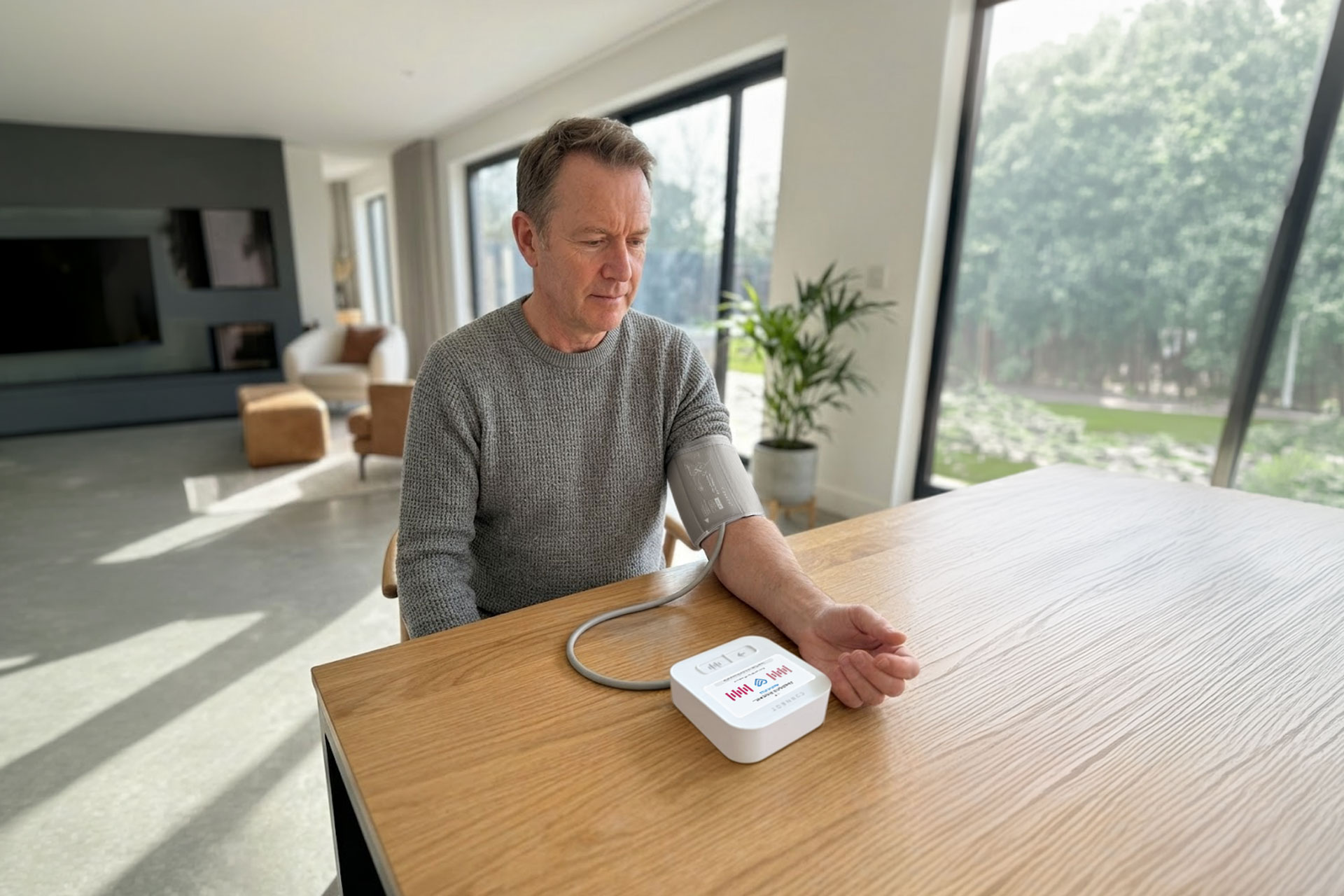
Rest your arm on a flat surface at heart level, palm facing up. A table or desk works well. If your arm does not naturally reach heart level, a cushion or folded towel underneath can help.
This is the single most consequential positioning decision in the measurement process. A 2024 randomized trial published in JAMA Internal Medicine found that resting your arm in your lap overestimates systolic pressure by nearly 4 millimeters of mercury. Letting it hang unsupported at your side pushes that overestimation above 6 millimeters of mercury.
Both of those errors are avoidable with one adjustment: arm on the table, at heart level, every time.
Place the cuff correctly
Remove any clothing from your upper arm. Cuffs placed over clothing produce unreliable results.
Position the cuff on your bare upper arm, with the bottom edge one to two centimeters above the bend of your elbow. The cuff should sit snugly but not tightly. You should be able to slide two fingers underneath it comfortably. If your monitor has a tube, position it so it runs down the inside of your arm, over the artery.
The middle of the cuff should sit at heart level. If you have already positioned your arm correctly on a flat surface, this should follow naturally.
Stay still and silent
Once the cuff is in place and you have pressed start, stay still. Keep your arm relaxed on the surface, your back supported, your feet flat. Do not talk, check your phone, or shift position. Even minor movement or conversation during the measurement can affect the result.
Wait until the device has finished and displayed the reading before moving. Then record the number before you do anything else.
Building a consistent routine
One reading is a data point. A week of readings is a picture. Building that picture requires a simple, repeatable routine.
Take two readings per session
After your first reading, wait one minute and take a second. Record both numbers.
The first reading in any session tends to run slightly higher than the second. This is normal. Your cardiovascular system is still settling, and the first inflation of the cuff can produce a mild alerting response. Recording both readings and averaging them gives a more accurate picture of your blood pressure than relying on the first number alone.
If your monitor stores readings automatically, check that it is capturing both. If it does not, keep a simple log: a notebook, a notes app, or a dedicated tracking sheet works equally well. The format matters less than the consistency.
Measure morning and evening
Take readings twice a day: once in the morning before food, caffeine, or medication, and once in the evening. Guidelines differ on exact evening timing, with the most recent US guidance recommending before bed and European guidance recommending before dinner. The key is choosing a consistent time and keeping it.
This morning and evening structure is the basis of what clinicians call the 722 protocol, two readings per session, twice daily, for seven days. It is the approach recommended by both sets of guidelines as the most reliable method for establishing a meaningful home blood pressure average.
The seven-day window matters because blood pressure varies from day to day. A single day of readings, even taken correctly, may not reflect your typical pattern. Seven days gives your clinician enough data to draw a reliable conclusion.
Know when you have enough data
After seven days of morning and evening readings, you have a meaningful baseline. If your clinician has asked you to monitor over a longer period, follow their guidance. If you are monitoring on your own, seven days is a reasonable starting point for a conversation about what your numbers show.Blood pressure varies naturally from day to day and week to week. A single elevated reading, or even a few in a row, does not necessarily indicate a problem. What matters is the pattern across the full monitoring period. Why Does Blood Pressure Fluctuate? Causes, Patterns, and What to Do covers how to think about that pattern in more detail.
Quick reference
Use this as a checklist before, during, and after each reading.
Before you measure
- Rest quietly for five minutes. Back supported, feet flat, legs uncrossed, arm at heart level.
- Avoid caffeine, alcohol, nicotine, exercise, and large meals for at least 30 minutes beforehand.
- Empty your bladder.
- Measure at the same time each day. Morning before food, caffeine, or medication is the minimum standard. Morning and evening are ideal.
- Confirm your cuff fits your arm correctly.
- Use a clinically validated upper arm cuff device.
During the reading
- Remove clothing from your upper arm.
- Position the cuff on bare skin, one to two centimeters above the bend of your elbow, snugly but not tightly.
- Rest your arm on a flat surface at heart level, palm facing up.
- If your monitor has a tube, run it down the inside of your arm over the artery.
- Press start. Stay still and silent until the reading is complete.
- Record the result before moving.
After the reading
- Wait one minute and take a second reading.
- Record both results.
- Repeat morning and evening for at least seven days to establish a meaningful baseline.
What your numbers are telling you
Getting the technique right is the foundation. What you do with the numbers you collect is the next step.
A single reading is a starting point, not a verdict.
Blood pressure varies naturally from hour to hour and day to day. One elevated reading after a stressful morning or a poor night of sleep does not mean something is wrong. What matters is what your readings show across the full monitoring period.
If your readings are consistently elevated across multiple sessions over several days, that is worth a conversation with your clinician. Not because one pattern definitively means something, but because a clinician can put your numbers in context in a way that a monitor cannot. When Is Blood Pressure Actually High? covers what consistently elevated means and when it warrants follow-up.
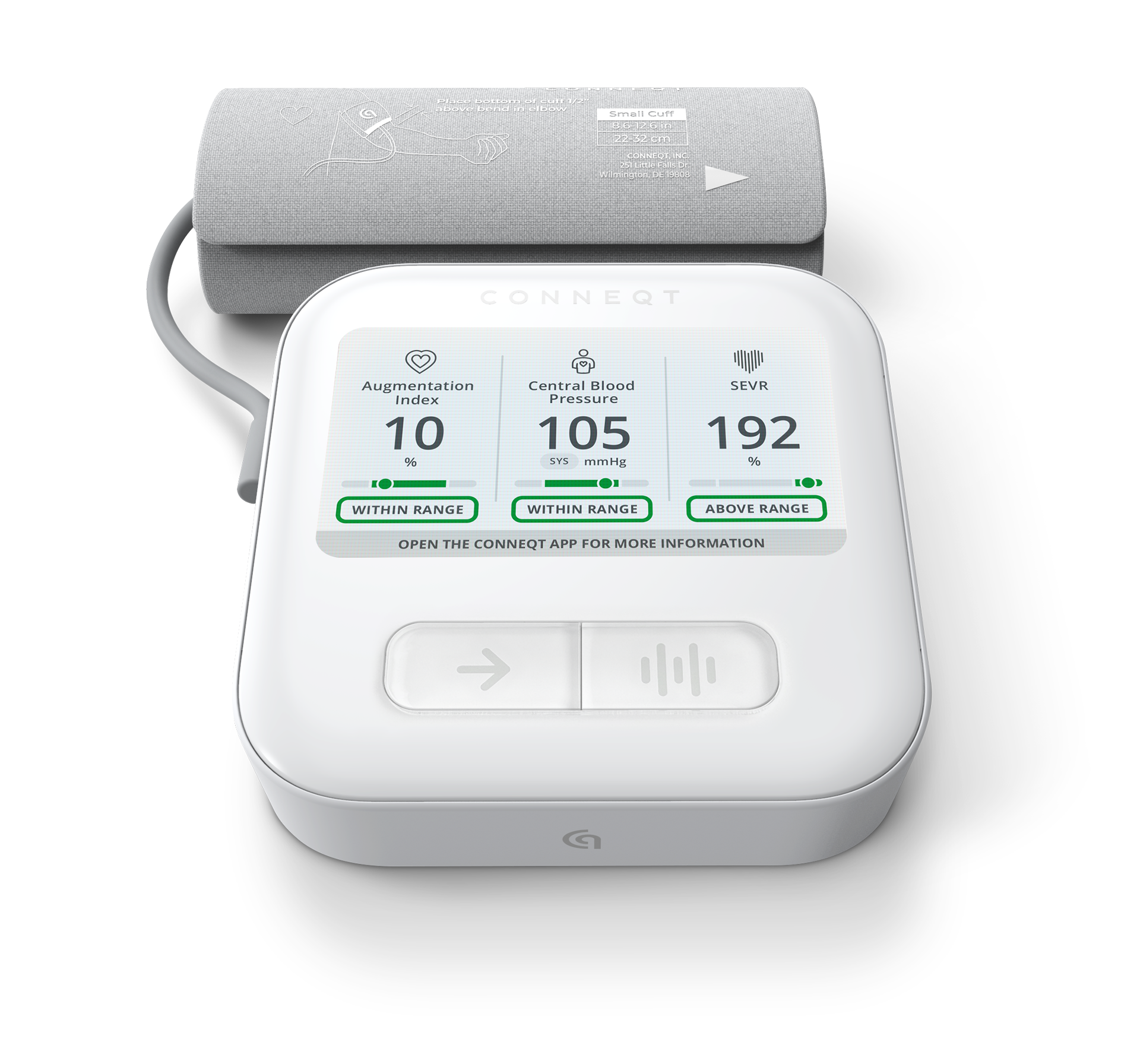
Blood pressure is one layer of cardiovascular health. Arterial function is another. The CONNEQT Pulse is a validated cuffed device that measures arterial stiffness and central blood pressure alongside standard brachial readings. For device-specific guidance on using the Pulse, How to Use the CONNEQT Pulse for Accurate Readings and Better Heart Health Tracking covers the full process.
Home monitoring done correctly gives you something a single office visit rarely can: a picture of how your blood pressure behaves across different times of day and different conditions. That context is genuinely useful in a clinical conversation. Rather than arriving with one number from a rushed visit, you arrive with a week of data taken under controlled conditions.
That is worth something.
What to read next
Now that you know how to take a reliable reading, these articles help you make sense of what you see.
- Why Does Blood Pressure Fluctuate? Causes, Patterns, and What to Do — A comprehensive look at what drives blood pressure variability, which patterns are worth paying attention to, and when variation becomes something worth discussing with your clinician.
- When Is Blood Pressure Actually High? — What consistently elevated readings actually mean, how to tell the difference between a one-off spike and a meaningful trend, and when to follow up.
- What Time of Day Should You Take Your Blood Pressure — Why morning and evening are the recommended measurement times, what each captures that the other cannot, and why consistent timing matters more than optimizing either one.
Want to explore more? Browse the full library.